Showing posts with label reviews. Show all posts

Wednesday, March 6, 2013

The Sweetness at the Bottom of the Pie - Alan Bradley

the sweetness at the bottom of the pie
alan bradley
c. 2010
347 pages
completed: 3/5/2013

read for: tbr pile

*may contain spoilers*


When Flavia de Luce finds a dying man in her cucumber patch early in the morning, she decides it's the most interesting thing to ever happen in her long eleven year old life. When that dead man is discovered to have old ties to her father, Flavia takes it upon herself to discover the truth. Could her father really be a murderer?

Until yesterday, I seriously hadn't finished a book since moving to Santa Barbara in September 2011. That's crazy. That's literally a year and a half! But now I can no longer say that's true and I'm so glad. I've tried a few times, claimed to be back, but I hope this time is really a true return to form.

Obviously I'm going to think any book that can pull me out of an 18 month slump is good. And to show my gratitude, I'm going to solely focus on the good in this review. Maybe that's not quite fair as there certainly were some aspects of the author's writing style that could use some improvement (such as a few passages that became a bit too expository when certain characters were recounting their history to Flavia), but I just don't care. There will be a chance for me to discuss that next time.

The subject matter the mystery revolved around are two hobbies I probably could not care less about: stamp collecting and magicians. But I was still kept engaged in the mystery. Enough information was given about each to understand their value and importance to the story, but I wasn't bogged down with useless knowledge that put me to sleep. Finding that balance can be difficult for authors writing for an audience that isn't going to be familiar with the subject.

Similarly, the audience wasn't inundated with irrelevant historical detail about the war. It was made clear that the effects of World War II were still felt in every day life in 1950s England, and the extent to which those effects shaped every aspect of Flavia's world was pressed upon us, but never was the audience subjected to a tangential history lecture. Instead, the atmosphere of Post War England and all that implied was delivered through Flavia herself: her voice, her values, her actions, and her relationships.

Flavia's voice was the best part of the book for me, and it's that above anything else that's compelling me to anticipate the rest of the series. She came alive on the page, just the mix of precocious, stubborn, and self important. She struggled with being the baby of the family, and the neglect and patronizing that came with it. She became quite indignant when she wasn't taken seriously or when under estimated. Yet at the same time, her childish qualities shone through and she could become quite the little beast when dealing with her sisters or the cook. I loved when Mrs. Mullet admitted to being quite aware of the de Luce's hatred for custard pie, and that she had been taking them home to her husband all these long years. All of a sudden Mrs. Mullet became a real person instead of just the dithering old lady Flavia had led us to believe her. Flavia's a bit unreliable in that way, so the reader has to be careful not to put all their faith in Miss de Luce.

Flavia's characterization often brought to mind the character of a young Briony Tallis from Ian McEwan's Atonement. She didn't remind me of Briony so much as she offered herself as a counterpoint (or perhaps in Miss de Luce's own vocabulary: an antidote). Briony is representative of a Pre War England. She is literature and poetry, romantic and idealistic. She is a child, an innocent, and is unable to grasp the gray in the world. Flavia, on the other hand, is England after the Blitz. She's been through the war and come out the other side. She is chemistry and poison, truth and rationality. Her eleven years old is more worldly than Miss Tallis could  have been. After her matter of fact discussion with Ned and Mary regarding Mary's brief attack in the bedroom, I'd be interested to see how Flavia would have reacted to all Briony witnessed. I've a sneaking suspicion life might have turned out quite differently for Cecilia and Robbie.

I feel I may have just gotten off topic...

I may be rating this just a tad high. It should probably only rate a 4, but I am going to be grateful for sometime to Alan Bradley and Miss Flavia de Luce for pulling me out of the book pit I had fallen in to. It's good to be back.

5/5

Wednesday, August 31, 2011

Bombay Time - Thrity Umrigar

bombay time
thrity umrigar
c. 2001
271 pages
completed 8/14/2011

read for: south asian challenge and TBR challenge

*may contain spoilers*

Bombay is awake.

Mehernosh Kanga, son of prominent Parsi lawyer Jimmy Kanga, is getting married today. Mehernosh has recently graduated from Oxford with his own law degree, but instead of choosing to practice in England or being lured away by the glamour of America, he has chosen to return to the city of his birth and join his father's firm in Bombay. The wedding of Mehernosh acts as an excuse for the residents of Wadia Baug, Jimmy and Zarin Kanga's own home, to gather and reflect on their lives together: the disintegrating marriage of Rusi and Coombi, the tragic love stories of Soli and Tehmi, the joy the group finds in their friendships with one another, and their ever changing relationship with the city of Bombay.

This was a surprisingly quick read about the lives of a particular Parsi community living in Bombay. The Parsis are an ethnic minority in India, a people descended from Persian immigrants who fled Muslim persecution during the 10th century. Much of their culture and how it differs from ethnic Indians, specifically their Zoroastrian religion, adds to their stories, their relationships with each other, and even more their relationship with Bombay. That being said, Parsi culture and religion was well integrated into the story without becoming overwhelmingly expository.

While certain characters are mentioned and seen throughout the entire book, each chapter is seen through the eyes of someone different. Each character gets their own story told, their triumphs and losses, how they became the men and women they are today. This is both good and bad; it's good in that each character has their own unique story to tell and it's good to see how the others fit into their story, but also bad because, for example, I really didn't like Coombi and didn't want to hear her story. Thankfully she was the only character I really didn't like. I had some issues with Tehmi, too, but that was a little different. While I liked the character of Tehmi, I didn't like how her story turned out. Every other character seemed so deeply rooted in reality that her breath problem after the death of Cyrus seemed out of place. It was too bizarre.

There wasn't too much overt description of the city of Bombay, no paragraphs of imagery describing streets and buildings, and yet Bombay itself became almost a character in its own right. Bombay changed with the times just as Rusi or Soli or Dosamai did, and its specific role in history had just as strong an effect on certain people as their neighbors. These stories might have turned out quite differently had they not occurred in Bombay.

4/5

Friday, August 19, 2011

I Will Repay - Baroness Emmuska Orczy

i will repay
baroness emmuska orczy
c. 1906
307 pages
completed 8/9/2011

read for: historical fiction challenge, TBR challenge, and scarlet pimpernel series

*may contain spoilers*

"Coward! Coward! Coward!"

In 1793, during the height of the French Revolution, Juliet Marney finds herself rescued from the Parisian sans-culottes by Paul Déroulède, a prominent figure in the National Convention. Déroulède is a passionate public speaker and is beloved by the people of Paris as a favorite of the recently martyred Marat and a staunch republican, someone who understands and speaks for the sans-culottes. Juliet and Déroulède continue to live together after her rescue, but soon realize that neither is exactly what they seem and could either be each other's salvation or damnation.

So, this is a Scarlet Pimpernel novel, but did you notice my complete lack of mention of the Pimpernel? Yeah, that was pointed. The Pimpernel is hardly in it at all. Yes, there is a daring rescue attempt by the end, and yes, you do eventually realize (or guess way in advance) that another minor though pivotal character from earlier in the novel was Sir Percy in disguise, but really this is not his story the way The Scarlet Pimpernel or Sir Percy Leads the Band are. This is very definitely the story of Juliet and Déroulède. I can see that some readers would be irritated by that, but I didn't mind it. I was definitively wrapped up in the story of Juliet and Déroulède, not to mention I just love reading about the French Revolution. But for others, the lack of Pimpernel could be a strong deterrent.

Orczy has an interesting voice as an author. I'm not sure how much of that comes from the time period she was writing in (1900s) or the subject matter, but she writes in an impassioned voice that's unusual in more modern works. It almost felt like she had written a speech (a really, really long speech) rather than a novel. In fact, I actually found that silently reading did a disservice to the prose and ended up reading most of it out loud. I realize that's super a little weird, and thankfully no one else was in the house, but it just seemed to sound better out loud. There are a lot of exclamation marks and bemoaning the fate of France at the hands of the sans-culottes.

I did have some issues with this particular edition (of course, I've since returned it to the library and so can't tell you which edition). There seemed to be quite a few typos. I mean, not on every page of anything, but enough so that I felt it to be distracting (especially while being a dork and reading out loud).

I just finished my very last college course (the final was literally this morning) which was on the French Revolution and it honestly made it so much more enjoyable to read this. It was like a supplement to the course, being able to read the story but pick out the events and figures that we'd been studying in class. I find it best to read historical fiction like this when I really feel like I know the basics of the period.

4/5

Thursday, August 11, 2011

The White Queen - Philippa Gregory

the white queen
philippa gregory
c. 2009
445 pages
completed 8/3/2011

read for: historical fiction challenge and read from my shelves challenge

*may contain spoilers*

In the darkness of the forest the young knight could hear the splashing of the fountain long before he could see the glimmer of moonlight reflected on the still surface.

When she walked with two sons to the crossroads to wait for the king, Elizabeth Woodville, a widow at age 27, only planned to ask for her dead husband's lands back. She didn't intend to fall in love and become Queen of England. Despite the rise in prominence and power her new position brings to her family, it also brings political struggles and death. Elizabeth makes instant enemies in those who don't like her influence over the king. Not to mention, the country is far from stable as cousins fight each other, each with a claim to the throne.

I've read all of Gregory's Tudor novels, but this is the first of her new series about the Cousin's War (more widely known as the War of the Roses). I think the third in the series comes out later this year and with (maybe?) a fourth one still to come. For anyone who keeps up with me and is familiar with this series, you can probably guess that it makes me crazy that the series' are not written in chronological order. So I try to look at them as stand-alone novels, and for the most part they can be. This book ends with a slight cliffhanger that hopefully gets picked up in a later novel, but otherwise they can be fairly solitary.

The last two Philippa Gregory books I read were split into three narratives, but this one reverts back to having only one. To be honest, I think this books could have benefited from having other narrators along with Elizabeth. Possibly someone like Elizabeth's brother Anthony or something like that (though I realize Anthony would prove to be a problem as a narrator 100 pages or so before the end of the novel)? My reason for this is that there's a lot of time when Elizabeth's not really doing anything, but there's so much going on politically and militarily. As a reader, I felt those episodes would have benefited from a more first hand account. There was just so much action that Elizabeth wasn't privy to that I felt her lone narration did a bit of disservice to the whole story. It could get a little boring with Elizabeth stuck in sanctuary just hearing about the battles. Not to mention, I honestly found the character of Elizabeth a little...I'm not sure, but I wasn't wild about her. She was a little too ambitious at the risk of her family, a little too calculating. Sadly much of her calculations didn't pan out the way she wanted.

One thing I was genuinely happy about was the relationship between Elizabeth and Edward. So often queens in these stories are so very unhappily married, and it's that unhappiness that adds weight and strength to part of their character. So many royal marriages are just horrible and so depressing to read about, which made the genuine love and devotion shown between Edward and Elizabeth incredibly refreshing. In fact, seeing as Elizabeth herself was not what was really drawing me into the story, upon the death of Edward and therefore their relationship I lost a lot of momentum in reading (the first 300 pages were read in three or four days and then the last 100 pages took me a few weeks). Their relationship was definitely uncommon. Politically, it made much more sense for Edward to marry a European princess, someone who could solidify his position as king. And with another royal family behind his children, I feel the little princes would have had a much stronger chance of surviving his death. Of course this is nothing but speculation...

Speaking of relationships, while I wasn't always wild about Elizabeth herself, I did greatly enjoy her family. Again, sometimes in historical fiction specifically about royalty, families don't act the way normal families do (being as they're not normal families). And that's definitely seen in the tenuous relationships between Edward and his brothers George and Richard. But Elizabeth and her family actually loved and supported each other. I loved her mother and I especially loved her brother Anthony. And I was glad we didn't spend too much time with her children other than her daughter (also named Elizabeth). I think it would have been too horrible to get attached to her sons.

I do have to point out that I could have done without the supernatural elements. I understand the reasons for adding them, that Elizabeth's mother was arrested (though acquitted) for witchcraft and that the women of the family claimed to be descendants of Melusina the water goddess, but I found they detracted from the book. I think I could have gotten behind Jaquetta and Elizabeth practicing witchcraft a little more if the results were more ambivalent, but I didn't like the blatant use of magic.

I think this was definitely a good start to a new series. Gregory does a good job of taking historical questions (such as the mystery of the princes in the tower) and creating very plausible answers for them. Of course we don't know what really happened, but the way the answers are presented make for a good argument or at least an interesting possibility. I'm looking forward to continuing the series with The Red Queen.

4/5

Wednesday, August 3, 2011

Theft: a Love Story - Peter Carey

theft: a love story
peter carey
c.  2006
269 pages (102 pages read)
stopped reading 6/28/2011

read for: i want more challenge

*may contain spoilers*

I don't know if my story is grand enough to be a tragedy, although a lot of shitty stuff did happen.

Michael Boone, known affectionately as Butcher Bones by his brother Hugh, used to be a famous artist in Sydney, Australia. Now, however, after losing his wife and his son and much of his work in a nasty divorce, he's not much more than a broke, drunk has-been. Forced to leave Sydney, Boone and his brother take up residence as caretakers for an old patron's country property. Their lives are quiet until they meet Marlene, a women who lets them know their neighbor is the owner of a priceless painting, a missing Liebovitz. Just days later, the painting goes missing and, being one of the only people to know of its existence and whereabouts, Boone is accused.

And...that's as far as I got. So if this book goes on to be about something else, I'm sorry for misinforming you.

There's nothing overtly wrong with this book. I'm not throwing it down in disgust or anything. In fact, a part of me that vividly remembers how much I loved Oscar and Lucinda thinks maybe I put it down too soon. I haven't managed to take it back to the library yet, even though I stopped reading over a month ago and am even currently sitting in the UW Suzzello Library Cafe. I just got confused. There's some stuff that I don't understand and after 100 pages I'm not invested enough to see if continuing on will clear anything up. So I put it down. But I'm still not sure...we'll see...

1/5 unless I pick it up again.

Sunday, July 3, 2011

Doctor Faustus - Christopher Marlowe

doctor faustus
christopher marlowe
premiered 1592
69 pages
completed 5/29/2011

read for: HSTEU305 (european witch trials)

*may contain spoilers*


Not marching now in fields of Trasimene / Where Mars did mate the Carthaginians, / Nor sporting in the dalliance of love / in courts of kings where state is overturned / Nor in the pomp of proud audacious deeds / Intends our muse to vaunt his heavenly verse.

A fifteenth century German, Georg Faustus, was a learned man with a reputation for magic. He studied at Heilderberg where he showed an interest in occult topics and was an example of the Renaissance magic tradition, a renewed interest in sorcery and other such learned magics. He was an actual figure around whom myths and legends have sense sprung up. Christopher Marlowe's Doctor Faustus is just one of many versions of this tale. In his play, Doctor Faustus is a learned man with an insatiable thirst for knowledge and power. He sees magic as the ultimate form of both and so makes a pact with the devil, his soul in exchange for twenty-four years of magical power. As the time for payment draws near, Faustus grows fearful and contemplates whether his damnation is inevitable or if its not too late to repent.

I read this for school, for my History of European Witch Trials class (which I kept accidentally referring to as simply my "witchcraft" class, as if I'd ditched the University of Washington for Hogwarts) and wrote a paper on it, so I was reading it for a very specific purpose. Rather than for enjoyment in the story, I was reading it as a text on Reformation belief in diabolism (demon worship) and the rejection of Catholic tradition. And in those instances, there is a wealth of information (enough to write an 8 page paper) from the deeper theological questions (if this is a Reformation text, is Faustus automatically damned for his diabolism or is there room for repentance?) to the more comically superficial (such as Faustus demanding Mephistophiles, his demon friend, appear to him as a Franciscan friar). Which is probably good, seeing as how otherwise, it's really kind of boring. Faustus is kind of a jackass. He didn't have enough depth to him to make me care why he chose to consort with devils. Not a whole lot happens, either. I wish when he got his powers he actually used them for something. Instead he did a few tricks and at one point traveled to Rome to screw with the Pope. But there was nowhere near twenty-four years worth of magical happenings. Not even twenty-four years of mischief.

I do think a good portion of my boredom comes from reading the text as opposed to seeing it performed. It's one thing to actually see devils carry him off to his fate at the end of the play, leaving the viewer without a concrete resolution (sometimes it just goes dark, sometimes screams are heard, and sometimes bloody limbs are thrown back on stage as if the demons tore his soul right out of his body), but reading nothing but sparse stage directions leaves a reader a little cold.

There's a faction of people who believe that Christopher Marlowe was the actual author of all Shakespeare's plays, and after reading this I have to believe those people are crazy (no offense if you're on of those crazies). There's a reason why Shakespeare is taught over and over, with whole classes devoted to nothing but his work, and why Christopher Marlowe is relegated to a week in my History of Witch Trials class.

3/5

Monday, June 27, 2011

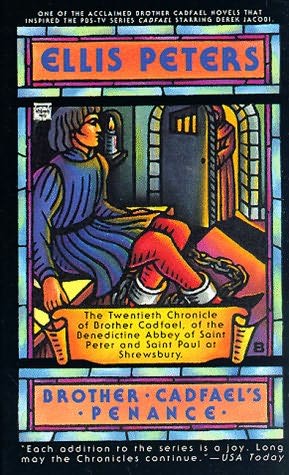
Brother Cadfael's Penance - Ellis Peters

brother cadfael's penance
ellis peters
c. 1994
292 pages
completed 5/23/2011

read for: historical fiction challenge

*may contain spoilers*

The Earl of Leicester's courier came riding over the bridge that spanned the Severn, and into the town of Shrewsbury, somewhat past noon on a day at the beginning of November, with three months' news in his saddle-roll.

The last adventure of the series sees Brother Cadfael embark on a personal mission. King Stephen and Empress Maud show no signs of ending their civil war and after the loss of a battle, many of the Empress' men are imprisoned in the castles of the King's men, most available for ransom, but some not. Cadfael discovers one of those men to be Olivier de Bretagne, the son he had only recently learned of. Cadfael travels with Hugh to a peace conference between the two factions in the hopes of discovering his son's whereabouts. While there, a murder takes place and an old friend of Cadfael's is accused, Yves Hugonin, now the brother-in-law of Olivier. Yves is taken prisoner by the same man whispered to be holding Olivier. Now Cadfael has two men to rescue, but his leave from his duties does not extend past the conference. Cadfael must choose between the home he loves and a son who has no knowledge of his father.

It's taken me a long time to get around to reviewing this. To be honest, I'm devastated that I read the last book. There's no more Cadfael. I've read all the books and seen all the Mystery! episodes (you should really rebroadcast those, Masterpiece Mystery). When I read the last page I seriously considered starting the first book over again. But no...I am finished. It's time to find a new mystery series (preferably one starring a Benedictine monk with his best friend the Sheriff of Shropshire).

This installment is a little odd in that the murder mystery plays a serious second banana to the story of Cadfael rescuing Olivier. This was somewhat similar to Summer of the Danes except in this case I was super enthralled with by Cadfael's rescue mission so I didn't really mind/notice the lack of mystery. 

The best part of the book, for me, was the odd friendship that developed between Cadfael and Phillip Fitz Robert, Olivier and Yves' captor. I think it's a testament to Peters' skill as an author that while Phillip could have easily been nothing but a monster, instead his relationships with Cadfael, Olivier, and even his father show him to be so much more. He turns out to be an extremely complicated and intelligent man, and one who was quite likable. Yes, his treatment of Olivier was unfair, but when it's understood it almost comes across as reasonable. His motives behind his more treasonous actions excellently add to his complexity. He is not a traitor for personal gain but for peace - anything to end the bloodshed. His grey thinking can't be understood by the black and white Olivier, making their relationship especially tense, but is understood by Cadfael. I was glad when he let Olivier go and then Olivier returned the favor by rescuing him from Empress Maud.

I was especially moved by one particular moment in the book. Empress Maud had attacked Fitz Robert's castle and when all was definitely lost and himself severely wounded, Fitz Robert allowed Cadfael to let Olivier out. The two then devised a plan to escape with Fitz Robert. It is during this meeting that Cadfael and Olivier come together both in full knowledge of their father/son relationship for the first time, and Olivier has to ask him for help into his armour and says "If I am going, as well go quickly. This once, my father, will you be my squire and help me to arm?" and I don't know. I was moved.

Lastly, I felt the ending was the perfect way to close out the series. To be honest, I wish there could have been one last scene between Cadfael and Hugh, but I don't think it could have been worked in. It would have been disrespectful and out of character to visit him before the Abbot, and it would have been anti-climactic after Abbot Radulfus' simple and beautiful "Get up now, and come with your brothers into the choir." So I'll take it as it is and just know in my heart that Cadfael and Hugh had many more adventures together.

If you haven't read these books, you need to immediately.

5/5

Wednesday, June 22, 2011

Maurice - EM Forster

maurice
em forster
c. 1913
246 pages
completed 6/20/2011


*may contain spoilers*

Once a term the whole school went for a walk - that is to say the three masters took part as well as all the boys.

Maurice tells the story of Maurice Hall, a middle class boy growing up in Edwardian England. At Cambridge he befriends Clive Durham, and as the two become intimate their friendship quickly blossoms into love. Though the two remain almost inseparable during the first few years after they leave university, a trip to Greece causes a change of heart in Clive. He comes home "fixed" and marries a woman names Anne, breaking Maurice's heart. Due to his devastation at losing Clive, Maurice too becomes determined to cure himself of the "disease" of homosexuality.

I think I kind of read this at a bit of the wrong time. I watched the movie due to a recent actor obsession (damn you BBC Sherlock and your silver fox Lestrade - who can be seen in the sidebar as my current tv boyfriend) and completely fell in love. I thought the movie was excellent and kept watching bits of it over and over on youtube (especially Maurice and Alec's last scene at the boathouse). Then I discovered my sister owned the book so I had to read it immediately, and so since I'm currently so enamored of the movie and Alec Scudder especially, I don't know how objective I can be about the book.

This book was written in 1913 but due to its subject matter (where the main character is not only a homosexual who is portrayed mostly positively, but one who *SPOILER* gets a happy ending with the man he loves) wasn't published until the 70s, after Forster's death. So it's less known than some of his other works. I found it interesting that though homosexuality is obviously the crux of the novel, it is the class distinction and tension between Maurice and Alec, something always featured so prominently in Forster's work (I say this like I've actually read anything else of his - well, I've seen the movies!), that is really the more pervading issue. Alec is only the under gamekeeper of Penge and Maurice is a guest there. As such, Alec isn't even noticed by Maurice (or even the reader really) for quite sometime. The use of a homosexual relationship, bringing two men of very different backgrounds together, is an interesting way to showcase the beginning disintegration of the European class system during this time. I love when books are obviously about one thing but are really, sneakily about something else, too.

It took longer for me to read this than I think I would have had I not seen the movie. It's Maurice and Alec who are the real love story (or to be fair to Clive's love for Maurice, they are the happy ending) and so I did feel like I had to slog through Clive a bit in order to get to Alec. Not that Clive is not a worthwhile or interesting character. His sudden abandonment of his homosexual leanings is a curious thing. It's a little ambiguous as to whether he really did grow out of it or if he still held those feelings but no longer allowed himself to act on them. The movie gives an actual answer to this question by adding a sad ending to the story of Clive and Maurice's university pal Risley that's not in the original story. While some purist may be super against this addition by the filmmakers, I actually thought it added a lot. It explained Clive's transformation and also made it clear to modern viewers just how dangerous it was for homosexuals at this time in England. Readers in 1913 (even though the book wasn't published then) would be aware of the dangers, whereas people today might not realize it was a jail-able offence (and had at one point in English history been an offence worthy of execution). Anyway, like I said, even though Clive is an intriguing character, I was impatient to get to Alec who is just so wonderful.

I just loved this story, book and movie alike, and I am pretty sure they'll be ones I revisit again and again.

5/5

Tuesday, May 24, 2011

The Improper Life of Bezellia Grove - Susan Gregg Gilmore

the  improper life of bezellia grove
susan gregg gilmore
c. 2010
256 pages
completed 5/9/2011

read for: i want more challenge

*may contain spoilers*


Apparently among those who consider their social standing some measure of importance, I am to be admired for I am one of the view Nashvillians who can claim with infallible certainty that a blood relative had lived in this town since its inception.

Bezellia Grove is the last in a long line of first born daughters named for their pioneering ancestor who picked up her dead husband's musket in order to fight off the attacking Chickamauga tribe (though the accuracy of the story is debatable). Growing up in an affluent and wealthy family, Bezellia's life should be breezy and idyllic. But as her mother descends into alcoholism, her father becomes more and more distant, and her younger sister enters her teens still making mud pies and clinging to her doll Baby Stella, Bezellia's life is anything but. She finds herself drawn to the family she creates from the African American help, Maizelle the family cook and Nathaniel the driver. Her life takes a turn when she develops a friendship with Nathaniel's son Samuel and Bezellia is introduced to 60s Tennessee racism first hand.

While I have to admit I enjoyed Gilmore's first novel Looking for Salvation at the Dairy Queen better, I still really enjoyed Bezellia. Southern lit like this can sometimes be dismissed as merely fluff, but she tackles some heavy topics like alcoholism and racism and inter-racial relationships in a very realistic and non sugar coated or fantastical way. I found the inclusion on some not-so-nice remarks from Bezellia's cousin, who was all for Bezellia's crush on Samuel, to be more telling of the blatant racism than any of Mrs. Grove's hysteric outburst. Mrs. Grove is portrayed throughout much of the book as a somewhat larger than life villain (before we come to see her as more complex) so it's kind of accepted that of course someone like that would be racist. But Bezellia's cousin is supposed to be a good character, someone on Bezellia and Samuel's side. For her to make those comments shows how deeply rooted the racism was.

I did find some fault (maybe that's the wrong word??) in the characterization of Maizelle and Nathaniel. In my opinion, I viewed them as a little too...perfect? Against the villainy of Mrs. Grove they were almost angelic in their long suffering and unconditional love for Bezellia and her sister. I thought they were a little too influenced by Mamie or Uncle Tom stereotypes (Maizelle a little more than Nathaniel) in their devotion to Bezellia. It wasn't super blatant or anything, just something that I picked up on. Samuel, on the other hand, was an entirely different matter, a well rounded character and equal to Bezellia.

As for the ending, I was somewhat torn. The hopeless romantic in me wished Samuel and Bezellia could have taken on the world, but the historian in me was more satisfied that they didn't.

4/5

Tuesday, May 17, 2011

Slow Man - JM Coetzee

slow man
jm coetzee
c. 2005
263 pages (189 pages read)
stopped reading 4/30/2011

read for: tbr challenge

*may contain spoilers*

The blow catches him from the right, sharp and surprising and painful, like a bolt of electricity, lifting him up off the bicycle.

After being hit by a car while out riding a bicycle, Paul must relearn how to live and get around as an amputee, dependent on others. He refuses to entertain the idea of a prosthetic limb, opting instead to remain on crutches. Due to a lack of family, Paul is assigned a nurse to look him, Marijana, a Croation mother of three. Paul forms an attachment to Marijana and her children, but she is a married woman. Paul has to decide what, if anything, he wants to do. Helping him along is Elizabeth, an eccentric author who takes up residence in Paul's flat. Though Paul and Elizabeth have never met before this time, she seems to have more stake in Paul's action than would be expected.

Sadly, I didn't finish this book, so I don't know how Paul and Marijana's story ended. I have no idea if they got together (though I hope they didn't).

For the first third of the book, I was really enjoying it. It was a simple story, an older amputee falling in love with his younger and very married nurse. Their story was good. The developing relationship between Paul and Marijana's children was good. The confrontation between Paul and Marijana's husband was good. I was even amused by the fact that I had a hard time not pronouncing Marijana's name as marijuana. All good.

And then Elizabeth was introduced.

The introduction of Elizabeth completely changed the course of the book. Instead of a simple story of a man and his somewhat inappropriate love for his nurse, the book changed suddenly into a work of meta-fiction. Elizabeth was not only a character of the book, she was the author. She was pulling the strings, prodding Paul to act. Elizabeth interacts with Paul but he's not really a real person, he's one of her characters.

It's entirely possible I could have gotten behind this had the book held this meta theme from the beginning. But once I've gone through 100 pages invested in the relationship between patient and nurse, it's hard to shift focus to such a radically different relationship between author and character. I don't like when there is such a drastic shift in theme and focus.

I very much enjoyed the voice of the author which is why it took me so long to make the decision to abandon the book. I feel I should continue looking into JM Coetzee, but this book just turned out not to be for me.

1/5

Sunday, May 15, 2011

One Amazing Thing - Chitra Banerjee Divakaruni

one amazing thing
chitra banerjee divakaruni
c. 2009
220 pages
completed 4/13/2011

read for: south asian challenge

*may contain spoilers*

When the first rumble came, no one in the visa office, down in the  basement of the Indian consulate, thought anything of it.

Expecting an ordinary day with nothing more than a few inconveniences, several people have gathered at an Indian consulate in American. Each are preoccupied with their own lives and give little notice to each other as they wait to finish getting visas. Their lives quickly come together, however, when they are hit by an earthquake and become trapped in the basement of the consulate. As their situation becomes more and more dire, the companions, with little else to pass the time, tell each other their stories.

It hadn't happened in a while, but I read this book in only two days. Maybe not such a feat for others (as the book is only 220 pages) but I tend to read annoyingly slow. But I found this extremely hard to put down. I've been pretty unmotivated lately, either to read much or blog or even read other people's blogs, but I'm trying to get all three back on track.

I read this about a month ago, so the review may be a little lacking or disjointed, so I'm sorry.

I always find it especially enjoyable when I feel a personal connection to what I'm reading, especially if that personal connection is something somewhat arbitrary. Like when I'm reading a historical fiction novel and they happen to be discussing an aspect of history that I just learned about in one of my classes or something like that. In this book, I noticed pretty early on in their time together, that the group stuck in the consulate were going through the five stages of team building. When I served in AmeriCorps, we ended up having to talk about team building all the time, and we'd do all those ridiculous games and exercises to make sure we had smooth running teams. It's one of those things that is important to do, but everyone kind of hates doing it so you have to kind of make fun of it. I spent two years in AmeriCorps and we talked about team building (or I guess were lectured about team building) all the time. So it was kind of funny for me to read this and make note of when they transitioned into the next stage. For anyone interested the five stages are forming (when you first meet), storming (when everyone is fighting), norming (when the team starts to understand how everyone else works), performing (when you're able to work at the team's utmost potential), and celebrating (when the job's all done). I wish they could have come up with a rhyming word for the fifth stage.

I found myself enthralled with the stories told by the group of trapped people. Just as I like certain members of the group more than others (I'm looking at you, Mr. Pritchett. You were super annoying), I liked certain stories more than  others. I particularly enjoyed the stories set in India. I had no idea there was such a history of Chinese emigration to India and subsequent racism against them. I really enjoyed Mangalam and Malathi's stories of being almost forced to come to America. The Pritchett's stories both left me a little cold, however.

The only major issue I had with the book was the end, and part of that is just my own personal preference. I don't enjoy ambiguous resolutions, and we're left not knowing if the group is rescued and survives (for my part, I'm apparently a Debbie Downer because I don't think they did). And also, I don't think I totally got the ending of Uma's story, the deal with whether or not the aurora was real. I didn't realize that was questionable until she said she lied to Jeri. Maybe I should re-read the last chapter and see if I have any divine revelations.

4/5

Monday, April 18, 2011

Lady Chatterley's Lover - DH Lawrence

lady chatterley's lover
dh lawrence
c. 1928
324 pages (154 pages read)
stopped reading 4/10/2011

read for: back to the classics challenge, page to screen challenge, penguin classics, 1001 books

*may contain spoilers*

Ours is essentially a tragic age, so we refuse to take it tragically.

Only months after marrying Connie, Clifford Chatterley is wounded in the trenches of World War I. Though at first feeling pride in her duty to her husband, now paralyzed from the waist down and confined to a wheelchair, Connie soon finds herself feeling stuck in a loveless marriage and a meaningless life. As Clifford pulls away from his wife, becoming more involved with his new housekeeper and his writing, Connie searches for her own fulfillment in the form of a relationship with her husband's gamekeeper.

I'm not really sure if she ever find fulfillment since I didn't finish it. Even though I have feelings of failure whenever I put down a book, I'm trying to get myself to quit books I'm really not enjoying so I'm not just dragging my feet and can move on to something more enjoyable.

Two things that made me put down the book...First, I really couldn't get behind the relationship between Lady C and the gamekeeper. It seemed really forced. Neither of them seemed to provide any reason for any sort of attraction or affection for the other, and I felt their relationship began very bizarrely, based more on convenience or lack of any other option. Maybe I'm wrong and an understanding of their motives for entering into such a relationship becomes more apparent if I keep reading, but I was put off by their initial love scene. This was a time of sexual and social revolution for women and in England especially, it was quite explosive. So I would have expected Lady C to be less passive in the process.

Second, I have trouble at times when novels are neither plot nor character driven, but are instead given over to the author's musings on a specific philosophical or social issue (in this case female sexuality). Some musing is fine, but I start to tune out significantly when ruminations so greatly take the place of active narration. I like action. To me, that's important, and I feel it can replace and enhance too much musing and can often better show (as opposed to tell) an author's thoughts on whatever issue it is (s)he's musing over. Wilkie Collins is a good example of this (and the first that popped into my head), using No Name as a commentary on the absurdity of inheritance laws.

Last of all, I discovered this is one of those texts where I'm much more interested in its history and influence than actually reading it. The obscenity trial in England in the 60s is pretty interesting.

1/5

As I read this in part for the Page to Screen Challenge, check back later for my review of the 1992 miniseries.

Tuesday, April 5, 2011

The Fourth Bear - Jasper Fforde

the fourth bear
jasper fforde
c. 2006
378 pages
completed 3/23/2011

read for: global challenge, tbr challenge

*may contain spoilers*


The little village of Obscurity is remarkable only for its unremarkableness.

Though they received recognition and praise for their work in the Humpty Dumpty murder, things are not going so well for Detective Inspector Jack Spratt, his partner Sergeant Mary Mary, and the rest of the gang at the Nursery Crimes Division. After some bad publicity for using children as live bait in an investigation, the NCD is overlooked when the Gingerbread Man, a psychopathic murderer, escapes from an institution for the criminally insane, and the case is handed over to another department, despite Jack being the arresting officer when the Gingerbread Man was first incarcerated. With no new cases thrown their way, the NCD begin investigating a missing persons case brought to them by an antagonistic reporter. His sister Goldilocks, an investigating journalist, has gone missing. Though at first they seem to be looking into some illegal porridge distribution, Jack can't seem to keep out of the Gingerbread Man's way and it's becoming more and more clear that the two cases have some kind of connection. If only Jack and Mary were allowed to investigate...

I've now read both books in the series and am eagerly awaiting the next one. I really enjoy all the random nursery rhyme and fairy tale characters (especially when they're just a name-drop that could really be easily missed such as the shout out to Bobby Shafto) and the world Jasper Fforde has created. It's not quite as awesome as Sondheim's Into the Woods, an incredible Broadway musical which explores what happens after "happily ever after," but it's close.

While reading, I did think at times there was a little too much going on without quite enough explanation. I remember thinking this during the first book too. I don't mean within the mystery, that I could follow pretty well, but just in the world itself. The politics regarding the social status of PDRs (Persons of Dubious Reality) and anthropomorphic bears could get a little confusing. Maybe some people would find the immense complexities Fforde is able to create an asset, but for me it detracted somewhat, however that could be just my own shortcoming.

Like the first of the series, I really enjoy the characters. Jack and Mary work so well together. And even the smaller characters are well fleshed out, especially those with folkloric backgrounds. It was exciting to see the way the famous foibles and characteristics manifested themselves, and to get explanations for plot holes in the original sources material (such as the disparate temperatures of the three bears' porridge). Though they initially really annoyed me, I ended up especially enjoying the inclusion if Punch and Judy. I really appreciate Fforde's inclusion of more obscure folklore references. I would have liked a little more time spent with Prometheus and Pandora, since there's obviously a history there. I'm interested to see where that will go. Maybe in the next one.

One last thing I just want to mention, and this is the only thing about the books that really annoys me. I don't like the little excerpts at the beginning of each chapter. They're like clippings from magazines and newspapers and history books (fictitious ones from the Nursery Crimes world) and for me, they add nothing. In fact, after the first few chapters, I just ignored them entirely.

4/5

Tuesday, March 29, 2011

The Grapes of Wrath - John Steinbeck

the grapes of wrath
john steinbeck
c. 1939
619 pages (232 read)
stopped reading 3/28/2011

read for: back to the classics challenge, page to screen challenge, 1001 book, penguin classics

*may contain spoilers*

To the red country and part of the gray country of Oklahoma, the last rains came gently, and they did not cut the scarred earth.

Tom Joad is released from prison after serving a four year sentence for killing another man in a bar fight. He returns home to his family in Oklahoma and finds them packing all their belongings in one lone truck, having been pushed off the land in favor of faster and more cost efficient tractors. Deciding to break his parole, Tom joins his family as they journey to California in search of the American dream.

It took me two months and I only got this far. Some of that I can attribute to the end of the quarter and finals and all, but that's mostly an excuse. I wanted to like this book so badly! So much so that I may actually revisit it at some point. But for now I'm deciding to put it down. Despite writing my senior AP English paper on Steinbeck when I was in high school, I haven't read a whole lot of his work (in all honestly, of the three major texts I discussed in said paper, one of them actually was The Grapes of Wrath even though I didn't read it). The two novels of his I've read are not even quintessential Steinbeck. Instead of East of Eden or Of Mice and Men, I've read The Winter of Our Discontent and The Pearl. Both I really enjoyed, and I looked forward to reading his more popular work.

And there were things about Grapes I really enjoyed. Steinbeck has a beautiful voice, and he has an incredible ability to transport his readers with his words. And his characters are complex and flawed and deeply relatable, even though I've obviously never lived in Depression-era Oklahoma. Those elements were alive and well in Grapes and in those respects I really enjoyed it.

My problem reading The Grapes of Wrath came from the supplementary chapters. Every other chapter followed the story of parolee Tom Joad and his family's exodus to the bounty of California. The ones in between explored the experience of the Depression and the Dust Bowl on a more national level. These chapters were often beautifully written and were I to ever become a history teacher, many of them would be read in my class during our discussion of the Depression. However, for me, the way they broke up the action of the story completely stalled the momentum. Everything would come to a screeching halt, and the fits and starts kept me from fully engaging in what was going on. Like I said, maybe at some point I will try again, but for now I need to put it down.

1/5

Tuesday, March 22, 2011

Are you There God? It's Me, Margaret - Judy Blume

are you there god? it's me margaret
judy blume
c. 1970
149 pages
completed 3/13/2011

read for: back to the classics challenge

*may contain spoilers*

Are you there God? It's me, Margaret.

Margaret is an eleven year old girl who moves to New Jersey with her parents. While her parents are determined to raise their daughter as neither Christian of Jewish, her grandparents are tugging her in both directions and Margaret can't decide which one she thinks she is. While dealing with this internal struggle, Margaret also has to navigate a new school and new friends all while trying to grow up.

I read this for the Back to the Classics Challenge (see sidebar) in the category of young adult classics, because I think this is often touted as like the ultimate young adult book. As such, I feel a little weird reviewing it (especially since I didn't love it), so this will be a short review. Somehow I missed Judy Blume when I grew up. I mean, I knew of her and her books, but I was always more of a Ramona Quimby or Alice McKinley girl myself. I think maybe that's one of the reasons I didn't enjoy reading Margaret more now that I'm older. I don't have any nostalgic blinders on. Like, my sister the literature scholar and I like to have dance parties where we jam to the Backstreet Boys. We used to love the Backstreet Boys when we were much younger and had questionable taste in music. Had Justin Beiber and the Jonas Brothers come out in the 90s when we were that age we'd probably love them too. But since they didn't and we're all grown up now and have still questionable exceptional taste in music, we can't judge them with our little girl brains. We judge them with our all grown up brains and know that our tastes are far too sophisticated for Justin Beiber (except that one really catchy song, and only because they sang it on Glee). So that's how I feel about Judy Blume. Had I read it as a young adult maybe I'd still think it was awesome. But reading it as an adult?

I felt like the issues raised never got resolved. Like her confusion about God and that fact that her new best friend was not exactly a very nice person. And I have to say, I never knew anyone who was 11 or 12 and was as obsessed with getting their period as the girls in young adult books. It was not nearly as big a deal as its made out to be. Neither I nor any of my friends used it as a marker of how grown up we were and no on I knew was super excited for it to happen, seeing as how when it's never happened to you it just sounds kind of gross and inconvenient. I think some good issues were raised in the book, things that are important to talk about with kids, but it ended kind of flat for me.

3/5

Thursday, March 10, 2011

An Artist of the Floating World - Kazuo Ishiguro

an artist of the floating world
kazuo ishguro
c. 1986
208 pages
completed 2/26/2011

read for: i want more challenge, global challenge, historical fiction challenge, tbr challenge, 100 greatest novels, 1001 books

*may contain spoilers*

If on a sunny day you climb the steep path leading up from the little wooden bridge still referred to around here as "the Bridge of Hesitation,"you will not have to walk far before the roof of my house becomes visible between the tops of two ginko trees.

Ono is a retired artist living in post war Japan. One daughter is married and the other is just beginning her marriage negotiations. Negotiations fell through for Noriko a year earlier leading Ono to look back on his involvement in World War II and attempt to understand how his actions have affected his life and the lives of those around him.

This was an interestingly structured book. I often don't like books that aren't linear and this has a lot of nonlinear elements. It jumps back in time from what's considered the present (1948-1950 Japan) to different memories before, during, and immediately after WWII. But it worked out for me since there was still one underlying linear story: Ono working towards his daughter's marriage negotiation. It was through this one linear story that Ono visits his memories. This is a story with an unreliable narrator. He remembers things differently in 1948 than he does in 1950. He goes through a period of remembering himself as someone who acted with honor during the war to someone who claims to be able to take responsibility for working in a way that now is not looked on well, creating propaganda for the country. However, he never quite comes around to understanding the real root of his dishonor and what he did to so horribly tear apart certain people's lives.

Ono is an extremely complex character and despite thinking that he's changing his perception of himself, he actually continues on in a state of denial. Ono's daughters and grandson are less complex, but instead stand to represent changing attitudes in Japan (and actually much of the rest of the world). The older daughter, subservient and always at the very least acting as if she's giving way to her father's wants, is representative of pre-war Japan. The younger daughter, who constantly butts heads with her father, and Ichiro, Ono's grandson who dreams of being an America cowboy, are indicative of the vast Americanization that occurred as a result of the end of World War II. While their characters might not be overly complex, what they represent helps to shape Ono's character.

4/5

Friday, March 4, 2011

The Holy Thief Movie Review

the holy thief
1998
starring: derek jacobi, anthony green, benedict sandiford, and louise delamere

watched for: page to screen challenge

*may contain spoilers*

I know that I just said in my last movie review that I'm an advocate for people cutting movies based on books a break sometimes, but again I'm going to have to be a complainer for this movie. I've seen all of the Brother Cadfael episodes that were broadcast on "Mystery." In fact, I'd seen them all multiple times long before I ever started reading the series. But this is one of the few I've only rarely seen. I assumed that was simply due to Sean Pertwee not playing Hugh Berringar (because really, what's the point of watching if someone else is playing Hugh?), but after revisiting the movie for this challenge, I've decided there are two major problems, each containing LOTS of reasons to stay away. This movie installment is all kinds of terrible.

Problem One: Plot. TOTALLY, TOTALLY DIFFERENT! There's a somewhat different mystery (Daalny's been kidnapped, what?) and a completely different murderer and motive. Yes, I did feel like the motive in the book was a little weak and so I assume the filmmakers agreed which led to the change, and that I could totally get on board with, except what they changed it to made no sense to me. And became historically inaccurate.

Problem Two: Characters. Just about every character in the film is a major distortion of their print counterparts. In the book, Tutillo is mischievous and a bit of a rogue. You honestly feel there's a possibility he was the killer. In the movie he's nothing more than a wet blanket. Prior Herluin, though he's obviously in the wrong regarding St. Winifred and is a bit fanatically devout, is not nearly the ridiculous demonic caricature that's portrayed on screen. And Beaumont goes from being someone who's questionable and complex to a cruel and creepy creature. Even the regular characters are completely distorted. Hugh Berringar, Cadfael's best friend who's usually so fair minded and level headed and in basically ever way Cadfael's equal, is now an ass who inexplicably believes in ridiculous things such as dunk tests (where if you sink in water you're guilty) and cares less for justice and more for easy fixes. And saddest of all was Cadfael himself. I truely think Derej Jacobi IS Cadfael, but this episode had him picking fights and being snotty and cruel towards everyone and it was just horrible.

I really do mostly love these movies (especially One Corpse Too Many and The Sanctuary Sparrow) but this is the one to skip.

2/5 Read my review of the original book here.

Thursday, March 3, 2011

Of Love and Other Demons - Gabriel Garcia Marquez

of love and other demons
gabriel garcia marquez
c. 1994
147 pages
original language: spanish
completed 2/17/2011

read for: i want more challenge, what's in a name challenge, historical fiction challenge

*may contain spoilers*

An ash-gray dog with a white blaze on its forehead burst onto the rough terrain of the market on the first Sunday of December, knocked down tables of fried food, overturned Indians' stalls and lottery kiosks, and bit four people who happened t cross its path.

Don Ygnacio de Alfaro y Dueñas is a marquis in Spanish ruled South America (what is now Colombia), fading into obscurity with a wife who has been drugged into a state of near constant delirium. The daughter neither of them wanted has been pushed out of the house to be raised in the slave quarters, growing up speaking the Yoruban language of the slaves better than her own family's Spanish. It is only after she is bit by a rabid dog that Sierva Maria really comes to the attention of her father. Though she shows no signs of having contracted rabies herself, her bizarre behavior and mannerisms lead her father to conclude she is possessed by demons. Sierva Maria is sent to a convent to by exorcised. There, she develops a close relationship with Father Cayetano Delaura, the priest sent to oversee her ordeal, who may come to be possessed by an even more powerful demon: love.

Gariel Garcia Marquez is a beautiful writer. Beautiful. The emotional aspect of the detail is amazing. I always feel (I say always, yet this is only the second work of his I've read) that he is able to incorporate so much mundane life into his prose that in less capable hands would seem both irrelevant and kinda gross (in both this and Love in the Time of Cholera there is a passage or two that goes into some detail regarding specific characters' bodily functions). Instead, Marquez is able to make passages like those seem like such natural inclusions and ones that are vital to the integrity of the story. I don't often notice an author's prose style too much unless it bothers me, but Marquez stands out.

The novel (novella really) is very short, so there's not too much room for character development, but for those characters who needed it (Sierva Maria, Father Delaura, the Marquis) it was there in spades. Sierva Maria was quite the enigma. It's never really explained what her demon possession really is. For my part, I think her possession was nothing more than a cultural clash. She had been raised in the slave quarters, completely neglected by her family, so she was raised with different values, cultural norms, beliefs, and language. While differences like these would be expected from the African slaves, these perceived peculiarities were incomprehensible in their own daughter. Plus, she was basically tortured with "cures" for rabies, and that will really mess a person up.

I enjoy books that look into the historical practice of exorcism. It's often pretty terrifying and horrific, but fascinating at the same time. There were some extremely brutal processes to get rid of demons, and it's no wonder so many of them were fatal. My sister the literature scholar and I were discussing exorcist horror movies briefly last night, and I really think sometimes they should go the other way, with the horror part not being the person who's being possessed but the exorcism itself instead. Well, maybe they already do. I'm not so much into the horror movies...Scary stuff.

4/5

Friday, February 18, 2011

Full Dark House - Christopher Fowler

full dark house
christopher fowler
c. 2003
349 pages
completed 1/26/2011

read for: historical fiction challenge, peculiar crimes unit mysteries

*may contain spoilers*

It really was a hell of a blast.

After the death of Arthur Bryant, his partner for over fifty years, John May, detective of London's Peculiar Crimes Unit, is determined to find his friend's murderer. His investigation keeps bringing up references to the very first case he and Arthur ever took on together. John has to dig into his memory to a time of blackouts and bombs to remember a grisly series of murders at the Palace Theater in order to avenge his friend.

I am almost finished reading the Brother Cadfael books and so I'm looking for a new series of mysteries to take their place. I was a little wary going into this one, since my sister the librarian said it was boring, but I should have just remembered she's also told me "The Woman in White" was boring which has turned out to be one of my favorite books. I think this will do nicely as a replacement series (though don't worry, Hugh Berringar, no one will ever replace you in my heart). It's not nearly as long as Brother Cadfael, but I believe the author isn't finished writing them. Anyway, onto actually talking about the book...

Since it was the first of the series, this is the book where not only do we, the readers, get to meet Arthur and John and their band of peculiars, but they get to meet each other for the first time. I really liked the way the meeting was done. Instead of starting at the beginning, we meet them on the day of Arthur's death and then travel back 65 years or so to the London Blitz and John and Arthur's first case together. Seeing the parallel between the first case and Arthur's murder kept the two stories well connected.

I loved Arthur and John. They were a great odd couple and that's what you want in a somewhat comical detective duo, like Shawn and Gus from Psych or Booth and Brennan from Bones (though maybe without the latter's romantic tension - of course this is only book one so who knows). John's a perfect newbie straight man to Arthur's tragically comic eccentric. I also liked how young they are. John's nineteen and Arthur's barely into his twenties, yet here they are, forced by the war to grow up pretty quick. But they've still got quite a bit of youthful exuberance and naivete. 

Lastly, I love when a book makes constant reference to another work (in this case: the operetta Orpheus in the Underworld by Jacques Offenbach). I love getting introduced to something else through the book I'm reading.

4/5

Sunday, February 13, 2011

Scaramouche Movie Review

scaramouche
1952
starring: mel ferrer, stewart granger, janet leigh, and eleanor parker

watched for: page to screen challenge

*may contain spoilers*

I am usually a strong advocate for film versions of books. I think people sometimes can be extremely harsh in judging the transition from one medium to another and can be overly critical of every minute detail change. For this movie, however, I think I have to join the ranks of the overly critical. Now, there were certain changes I could understand and get on board with, such as condensing the story so that Andre's time in the theater troupe and his time learning to fence happened simultaneously. I understand changing the age of the Marquis to make it more believable to have him and Andre both vying for the affections of Aline. And I even understand changing Climene's name to the much less French Lenore (for a 1952 audience). But that's about as far as the understanding could go.

There was no point in making Lenore Andre's girlfriend from the get-go and Aline a girl he'd never met before. Aline went from being a strong-willed, spunky, and even sometimes arrogant young woman in the book to a demur child-like innocent in the film, just as Andre went from being a thoughtful and intelligent man to being basically a boor and a man-whore. I really couldn't understand the appeal of making Andre fall in love with Aline only to make him "discover" her to be his sister (he finds out later she's not). Who needs a gross incest subplot? Andre's whole family plot unfolds so interestingly in the book, and yet the way it was changed for the film honestly left me confused. I'm all for changes that make sense and/or enhance viewing pleasure, but these changes were pointless.

The thing I found the most ridiculous? In the book, Andre plays a pretty big role in the beginning of the French Revolution. French politics are the backbone of the story. The movie, however, reduced Andre's whole motivation to that of mere revenge, almost no politics in sight. The only reason the viewer would know this takes place during the French Revolution is the randomly added character of Marie Antoinette (not in the book) and Philippe's pamphlet blatantly subtly titled "Liberty, Equality, Fraternity." In the movie, Andre makes no political speeches and his role as Scaramouche in the Commedia is reduced to nothing more than a slapstick clown. Scaramouche is not just a clown. He's supposed to be a satirist. Also, if we're really going to get picky, he's supposed to be Spanish and dressed all in black (hence Freddy Mercury referring to him as a silhouette and asking him to fandango). If I wanted to continue in this vein, I could also complain about Lenore being called Columbine (Columbine was a soubrette, a flirtatious and mischievous servant, whereas Climene was supposed to be an innamorati, one of the lovers), but I'll let it lie.

To be totally fair, had I not read the book I think I could have enjoyed it a lot. In fact, I did manage to enjoy the second half once I'd gotten over my initial abhorrence to all the seemingly ridiculous changes. And I will note that it does have some historical value in having (one of?) the longest continuous swashbuckling sword-fights ever filmed (clocking in at over six minutes), which was a great scene. But it wasn't quite enough for me.

3/5

Read my review of the original book here.