Showing posts with label penguin classics. Show all posts

Monday, April 18, 2011

Lady Chatterley's Lover - DH Lawrence

lady chatterley's lover
dh lawrence
c. 1928
324 pages (154 pages read)
stopped reading 4/10/2011

read for: back to the classics challenge, page to screen challenge, penguin classics, 1001 books

*may contain spoilers*

Ours is essentially a tragic age, so we refuse to take it tragically.

Only months after marrying Connie, Clifford Chatterley is wounded in the trenches of World War I. Though at first feeling pride in her duty to her husband, now paralyzed from the waist down and confined to a wheelchair, Connie soon finds herself feeling stuck in a loveless marriage and a meaningless life. As Clifford pulls away from his wife, becoming more involved with his new housekeeper and his writing, Connie searches for her own fulfillment in the form of a relationship with her husband's gamekeeper.

I'm not really sure if she ever find fulfillment since I didn't finish it. Even though I have feelings of failure whenever I put down a book, I'm trying to get myself to quit books I'm really not enjoying so I'm not just dragging my feet and can move on to something more enjoyable.

Two things that made me put down the book...First, I really couldn't get behind the relationship between Lady C and the gamekeeper. It seemed really forced. Neither of them seemed to provide any reason for any sort of attraction or affection for the other, and I felt their relationship began very bizarrely, based more on convenience or lack of any other option. Maybe I'm wrong and an understanding of their motives for entering into such a relationship becomes more apparent if I keep reading, but I was put off by their initial love scene. This was a time of sexual and social revolution for women and in England especially, it was quite explosive. So I would have expected Lady C to be less passive in the process.

Second, I have trouble at times when novels are neither plot nor character driven, but are instead given over to the author's musings on a specific philosophical or social issue (in this case female sexuality). Some musing is fine, but I start to tune out significantly when ruminations so greatly take the place of active narration. I like action. To me, that's important, and I feel it can replace and enhance too much musing and can often better show (as opposed to tell) an author's thoughts on whatever issue it is (s)he's musing over. Wilkie Collins is a good example of this (and the first that popped into my head), using No Name as a commentary on the absurdity of inheritance laws.

Last of all, I discovered this is one of those texts where I'm much more interested in its history and influence than actually reading it. The obscenity trial in England in the 60s is pretty interesting.

1/5

As I read this in part for the Page to Screen Challenge, check back later for my review of the 1992 miniseries.

Tuesday, March 29, 2011

The Grapes of Wrath - John Steinbeck

the grapes of wrath
john steinbeck
c. 1939
619 pages (232 read)
stopped reading 3/28/2011

read for: back to the classics challenge, page to screen challenge, 1001 book, penguin classics

*may contain spoilers*

To the red country and part of the gray country of Oklahoma, the last rains came gently, and they did not cut the scarred earth.

Tom Joad is released from prison after serving a four year sentence for killing another man in a bar fight. He returns home to his family in Oklahoma and finds them packing all their belongings in one lone truck, having been pushed off the land in favor of faster and more cost efficient tractors. Deciding to break his parole, Tom joins his family as they journey to California in search of the American dream.

It took me two months and I only got this far. Some of that I can attribute to the end of the quarter and finals and all, but that's mostly an excuse. I wanted to like this book so badly! So much so that I may actually revisit it at some point. But for now I'm deciding to put it down. Despite writing my senior AP English paper on Steinbeck when I was in high school, I haven't read a whole lot of his work (in all honestly, of the three major texts I discussed in said paper, one of them actually was The Grapes of Wrath even though I didn't read it). The two novels of his I've read are not even quintessential Steinbeck. Instead of East of Eden or Of Mice and Men, I've read The Winter of Our Discontent and The Pearl. Both I really enjoyed, and I looked forward to reading his more popular work.

And there were things about Grapes I really enjoyed. Steinbeck has a beautiful voice, and he has an incredible ability to transport his readers with his words. And his characters are complex and flawed and deeply relatable, even though I've obviously never lived in Depression-era Oklahoma. Those elements were alive and well in Grapes and in those respects I really enjoyed it.

My problem reading The Grapes of Wrath came from the supplementary chapters. Every other chapter followed the story of parolee Tom Joad and his family's exodus to the bounty of California. The ones in between explored the experience of the Depression and the Dust Bowl on a more national level. These chapters were often beautifully written and were I to ever become a history teacher, many of them would be read in my class during our discussion of the Depression. However, for me, the way they broke up the action of the story completely stalled the momentum. Everything would come to a screeching halt, and the fits and starts kept me from fully engaging in what was going on. Like I said, maybe at some point I will try again, but for now I need to put it down.

1/5

Tuesday, January 4, 2011

No Name - Wilkie Collins

no name
wilkie collins
c. 1862
610 pages
completed 12/22/2010

read for: wilkie collins mini challenge, penguin classics

*may contain spoilers*

The hands on the hall clock pointed to half-past six in the morning.

Andrew Vanstone and his lady have a secret. Despite having two daughters who are quite grown up (Norah is 26 and Magdalen 18), Mr. and Mrs. Vanstone have only just last week gotten married. Due to English law in the 1840s, a wedding makes any previously written will completely null and void and unless specifically provided for, any illegitimate children unable to inherit. On their way to a lawyer to rewrite their will, Mr. and Mrs. Vanstone are accidentally killed, leaving Magdalen and Norah's future in the hands of their miserly and cruel uncle. Once realizing their uncle has no plans of following his brother's intentions and providing for her and her sister, Magdalen ventures into London with the aide of a charming swindler and his wife with a plot to reclaim her fortune and her name.

Out of the three Wilkie Collins novels I've read so far, this is probably my least favorite. That being said, it's still one of my favorite reads of 2010. Wilkie Collins has definitely become one of my favorite authors, and I plan to read many, many more of his works. Unlike the others I've read, No Name wasn't a mystery or detective novel. There were some mysterious happenings in the first few chapters, but the family secret was quickly revealed as the major conflict for our heroine and not the end discovery. As such, No Name became a revenge thriller, with Magdalen Vanstone fighting to reclaim her fortune and more importantly her identity. In this novel, Wilkie Collins made sure to include a good deal of social commentary on inheritance laws of the time, some of which seem quite bizarre (such as a wedding completely voiding any wills previously made by the couple, either male or female). Magdalen lost her name and her fortune on a mere technicality, despite the obvious plans of her beloved father.

For me, the story took a little while to really pick up, which is why I've labeled it as my least favorite among the three. Magdalen didn't really begin her schemes of revenge until well after half the book had gone by. I realize that certain things needed to be established, such as her family life before the deaths of her parents and her ability on the stage, and those parts were interesting and well written, but 300 pages is a lot to go through before the REAL story starts. Once she took up with Captain Wragg and she began her battle of wits against her enemy's housekeeper Mrs. Lecount (who was rather reminiscent of Count Fosco from The Woman in White) things really took off and became unput-down-able. Their scams were pretty ingenious and well executed and actually made me quite anxious through a good deal of them. So while not as consistently exciting as some of his other suspense novels, in the end it was still an incredibly thrilling read.

4/5

Saturday, January 1, 2011

As of 2011...

100 Greatest Novels: 23 out of 100 (23%)
1001 Books to Read Before You Die (Original): 51 out of 1001 (5.1%)
1001 Books to Read Before You Die (Updates): 2 out of 293 (.7%)
Entertainment Weekly's New Classics: 17 out of 100 (17%)
Penguin Classics: 54 out of 695 (7.8%)

Sunday, November 28, 2010

Candide - Voltaire

candide voltaire
c. 1759
78 pages
completed 11/28/2010

read for: HSTEU302 (modern european history 1648-1815), penguin classics, 1001 books

*may contain spoilers*

In the land of Westphalia, in the castle of the Baron of Thunder-ten-Tronckh, lived a youth endowed by nature with the gentlest of characters.

Candide, the bastard nephew of a baron on Westphalia, grows up studying under the tutelage of Dr. Pangloss. Pangloss is a firm believer in the theories of Leibniz, a German philosopher who poses a theory of optimism, that the world we live in is the best possible world. After engaging in sexual relations with the baron's daughter, Candide is driven from his home. This leads Candide on a journey across Europe, the Americas, and eventually the Ottoman Empire where a series of misfortunes causes Candide to seriously question the teachings of Pangloss and the theories of Leibniz.

I think this book could easily not be enjoyed without knowing the context in which it was written. I remember trying to read this before, but I didn't really know what it was trying to say since I didn't know what was going on historically in Europe at the time. I didn't even make it halfway though, which is sad considering the books is ONLY 78 PAGES LONG. Since I'm now reading it in my European history class, I was able to go through it pretty quick and appreciate it for what it really was, Voltaire's rebuttal to Leibniz's philosophy of optimism. Voltaire used this satire in order to write a social commentary on the state of the world at the time and the amount of suffering people go through on a daily basis at the hands of others as well as nature itself.

Without knowing the historical context, this book can be both pretty boring and horrific (for a comedy, there's a lot of rape and execution going on). Even knowing and appreciating the historical aspect of the book didn't make it a great read for me. While I enjoy history and was glad that I was able to know exactly what Voltaire was referring to in some of his more veiled metaphors, I don't really do philosophy. I don't really care if Voltaire thinks the amount of suffering within the world proves that there's no way this is the best possible world. But I read it, and I'm glad I did (seeing as I had to write a paper on it).

3/5

Friday, June 25, 2010

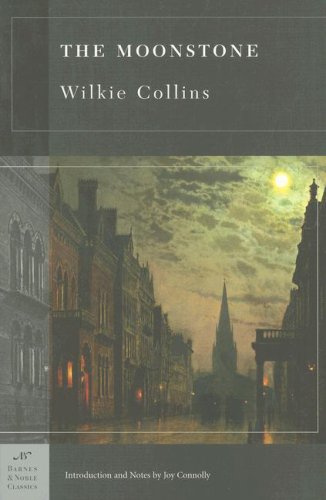
The Moonstone - Wilkie Collins

the moonstone
wilkie collins
c. 1868
494 pages
completed 6/24/2010

read for: wilkie collins mini challenge, penguin classics, 1001 books

*may contain spoilers*

I address these lines - written in India - to my relatives in England.

On her eighteenth birthday, Miss Rachel Verinder is surprised by a gift left to her by her late uncle Herncastle, a man mostly cut off from his relatives. The gift is an unusually large yellow diamond known as the Moonstone which she wears pinned to her dress throughout her birthday party. By the next morning, the Moonstone is gone. In a series of accounts written from different perspectives, those who were present on the night in question or those who had dealings with certain individuals of interest in the months after the theft, both the reader and all those involved are able to unravel the mystery.

I loved this book. LOVED IT! Set in Victorian England and hailed as the first English language detective novel, there is a lot of good stuff here: tension between the servants and those they serve, major red herrings in the mystery, the exotic excitement of Indian curses, sanctimonious religious zealots, and a lot of humor. I'm becoming a big fan of Wilkie Collins.

Because the novel is written in this specific epistolary style, each narrator has a very distinct voice and take on events and other characters. I found it really enjoyable to see how certain narrators portrayed themselves versus how other narrators saw them. For example, when Betteredge narrated he seemed so composed and respectable as the head steward of the Verinder servants, but when Mr. Blake or Mr. Jennings narrated, he was a little more quirky. The reader got to see Betteredge's feelings about the power of Robinson Crusoe, and then also see Mr. Blake and Mr. Jennings humoring this obsession. And by obsession, I mean he would read it the way some people read the bible. He would open it randomly and use the passage he first came to as advice or an omen. Another character who I found greatly changed between narrators was Mr. Bruff, the lawyer. Seen as so stuffy and judgmental as Miss Clack was writing her account, I was surprised to then find him so intelligent and thoughtful and kind throughout his narration and Mr. Blake's subsequent narration. Of course, by the end of her narration I was ready to take everything Miss Clack said with a grain of salt. She was just so ridiculously sanctimonious! I wanted to scream every time she tried to give someone else a religious tract (with titles such as Satan Under the Tea Table). I think she was the only character I couldn't wait to get rid of. Maybe Godfrey, too, but at least he was never a narrator.

I like a mystery where things get a bit convoluted before the big reveal. There's a big drug experiment close to the end of the novel where they tried to reenact the birthday party, and I kept having to refer to the first half of the novel to remember the little details that tuned out to be major clues. I like when every detail turns out to be important.

Unfortunately, there is one problem with this novel. Much like The Woman in White, another of Collins' most famous works, The Moonstone hasn't quite aged well. In the 142 years since its publication, we've come understand a little more about drugs and their effects. And while I have no personal knowledge of opium, having never chased the dragon myself, I'm pretty sure you can't manipulate circumstances into giving a person the exact same trip twice. So if you're not someone willing or able to suspend some disbelief, you might have a problem towards the end of the novel. It didn't bother me too much, but it could totally ruin the whole book for other readers.

Other than that one issue, I was enthralled the whole way through. It wasn't creepy or suspenseful the same way The Woman in White was, but it kept me thinking and guessing the whole way through.

5/5

Thursday, April 29, 2010

The Adventures of David Simple - Sarah Fielding

the adventures of david simple
sarah fielding
c. 1744
282 pages (102 read)
stopped reading 4/26/2010

read for: before i die challenge, penguin classics

*may contain spoilers*

Mr. David Simple was the eldest son of Mr. Daniel Simple, who kept a Mercer's Shop on Ludgate Hill.

After the discovery of a major betrayal at the hands of his previously beloved brother, David Simple takes to the streets of London to try to find someone who could be completely worthy of the title "friend." Written as a commentary on social groupings of the day, David flits from group to group experiencing the myriad social trappings and failings.

Seeing as I didn't finish this book, I don't know if David ever found somebody worthy enough to be called a friend. To be totally honest, I hope he didn't. As he continued to judge and find fault with one person after another, all I could think was maybe David should have tried to bestow that title on himself. Not once in the 100 pages I read did he look in on himself and recognize his own similar shortcomings and vices. Maybe if he did he would be more likely to look past the foibles of others and appreciate what they had to offer. True friends accept you unconditionally. Though again, I didn't finish so maybe he did by the end. I doubt it, but you never know.

It's difficult for me to read early novels like these. I think there were still a lot of things that were being figured out about what the novel was supposed to be, so plot and character development were often a little thin. In their place was some major social commentary and satire. And for me, while that can be enjoyable and interesting, I can only deal with so much before something in the plot has to move forward. As nothing ever did, I decided to quit. Though that does make me feel like a failure.

1/5

Saturday, April 10, 2010

Sister Carrie - Theodore Dreiser

sister carrie
theodore dreiser
c. 1900
501 pages
completed 4/9/2010

read for: hstaa303 (modern american civilization), penguin classics, 1001 books

*may contain spoilers*

When Caroline Meeber boarded the afternoon train for Chicago, her total outfit consisted of a small trunk, a cheap imitation alligator-skin satchel, a small lunch in a paper box, and a yellow leather snap purse, containing her ticket, a scrap of paper with her sister's address in Van Buren Street, and four dollars in money.

Sister Carrie is a small town girl who arrives in the big city of Chicago at the turn of the twentieth century. As the country, especially in the cities, is becoming more defined by consumerism, Carrie is swept along with it, longing for the nicer things in life. With a constant increase in her desire food nice clothes, nice food, and a nice house as her driving force, Carrie rises up from the menial world of the working class to a life of security and luxury. Carrie has to learn what this material world is worth.

I am taking a modern American history class this quarter and we read this book as one of our primary sources which led to a very interesting discussion on whether fiction of whatever medium (literature, movies, etc) should be considered as reliable source material for historical study. In my opinion, I think it absolutely can. This book is a great example. Written about the time period it was written in, it gives an incredibly detailed look at a lot of different aspects of like in the 1890s and 1900s. Books like this can give the reader a lot of insight into how the public viewed certain social and political aspects of the day. Sure, you have to be careful and do your research on the author and who the audience was meant to be, but you need to do that with any primary source. And fiction that is not written about the time period it was written in or not written directly about the subject it's commenting on can give the same sorts of insights. Again, you need to be careful not to read too much into what you're reading (sometimes King Kong is just a big gorilla), but metaphorical and allegorical fiction can also provide incredible insight (sometimes King Kong is a reflection on Western imperialism and treatment of aboriginal peoples). So yes, in my opinion, fiction just as much as anything else produced in any given time period reflects on its society in a way people can learn from.

Anyway, onto the book itself. With a lack of any sympathetic characters, it was hard to root for anyone and I like a book where I can root for someone. All three main characters, Carrie and her two gentlemen friends Drouet and Hurstwood, are all obsessed with attaining and maintaining wealth and social status. They were interesting enough for me to want to know what was going to happen to them, especially after Carrie and Hurstwood relocated to New York, but for me the characters were not exactly what made this book enjoyable for me. Instead, I was pretty fascinated by the detail of daily life that was included and really enjoyed the addition of important currant events. There were intricate descriptions of factory work, what areas of the city were considered fashionable, how the poor were treated, and some kind of unorthodox relief services for the unemployed and a long segment on the Pullman car strikes that involved one of the characters as a scab.

This book provided a lot of commentary on many social aspects of the turn of the century, most especially the nation turning to be defined by consumerism. But also interesting was the way it kind of challenged ideas on what was morally acceptable for a woman and on gender roles in particular. For example, there was a lot of controversy when this book was first published. Carrie makes some decisions that were maybe not the moral norm of the time, but nowhere throughout the book is she censured for these decisions.

So to sum up, I definitely enjoyed this book and thought it was a great choice for a class studying the beginning of the twentieth century. The story is entertaining, the rise of Carrie and the decline of Hurstwood, but like I said the characters aren't exactly sympathetic. But I think you could get over that, especially if you were interested in the time period.

4/5

Friday, January 1, 2010

As of 2010...

100 Greatest Novels: 21 out of 100 (21%)
1001 Books to Read Before You Die: 37 out of 1001 (3.5%)
Entertainment Weekly's New Classics: 10 out of 100 (10%)
Penguin Classics: 46 out of 695 (6.5%)

Saturday, December 12, 2009

Anna Karenina - Leo Tolstoy


anna karenina
leo tolstoy
c. 1877
817 pages
completed 12/10/2009

read for: comp lit 211, 100 greatest novels, 1001 books, penguin classics

*may contain spoilers*

Anna Karenina is a story of a woman, unhappy in her marriage, who seeks love elsewhere with disastrous results. As a counterpoint, this is also telling the love stories, whether tragic or joyful, of other people in Anna's life.

I have been planning on reading this for some time, but just couldn't get around to it. Thankfully school, albeit a really terrible Lit class taught by someone I have nicknamed "Dr. Butthead," has forced me to read it. It's a little daunting, at 817 pages, but is actually a pretty steady read. As Rory Gilmore said, Tolstoy wrote for the masses. So it's not filled with prose that's attempting to be overly poetic and fancy. It's plain and simple which makes for an easy and compelling read.

I will be totally honest and say that I actually did NOT like Anna. I felt bad for her, obviously. She's in a loveless marriage with a man 20 years her senior in a time where that was not uncommon and there was not a whole lot you could do about it. But even so, I feel like she made a LOT of bad choices. Letting Vronsky come to her house, not divorcing Karenin when she had the chance. And it was hard to watch her throw her child away and cling so hard to Vronsky which in turn caused Vronsky to pull away from her. I always got a little bummed when the book switched back to her story line.

On the flip side, I enjoyed every page involving Levin and Kitty. Even when Levin was just chillin in his fields working with the muzhiks I was entertained. I enjoyed the ups and downs of their relationship, the little squabbles they had to work through and the personal quirks they had to get used to. It wasn't as loudly passionate as Anna and Vronsky; instead it was quiet and sweet. And I liked that.

4/5

Sunday, November 15, 2009

The Scarlet Letter - Nathaniel Hawthorne


the scarlet letter
nathaniel hawthorne
c. 1850
166 pages
completed 11/15/2009

read for: comp lit 211, 100 greatest novels, 1001 books, penguin classics

*may contain spoilers*

Hester Prynne, a woman living in Puritan Boston, is sentenced to live out her life with a scarlet "A" emblazoned on her dress after she bears a child out of wedlock. For the next seven years, she tries to devote her life to her child, Pearl, but her life is inevitable intertwined with the lives of two men from her past, Roger Chillingsworth and Arthur Dimmesdale. One man is destroyed by guilt and the other consumed by a relentless pursuit of revenge until finally all their secrets are revealed.

I had to read this for the first time in eleventh grade English (back in 2002) and now have to read it again for my Comparative Literature class. Now, normally I don't review books I've read before. I don't really see the point. However, if I'm being honest (and Dad, this is about where you should stop reading this sentence), I didn't actually read this in eleventh grade. I maybe made it through four chapters. Sorry, Mrs. Davies, I kind of faked my essay. But I have turned over a new leaf what with going back to school this year, so I am actually finishing all the books I'm assigned. Which is impressive for me. But onto the Scarlet Letter...

I have to say, I am not a fan. Apparently Nathaniel Hawthorne originally meant for this to be a short story and then someone else suggested he make it into a full novel. I feel this someone else gave Hawthorne some bad advice. This story could have been told in probably half the amount of pages Hawthorne took to tell it, and possibly then it would have been more entertaining for me. As it is, I kind had to slog through it. There's too much back and forth between action and reflection for me. I felt like every other chapter progressed the story and then the chapters in between were reflections on what just happened or what was about to happen. And sometimes Hawthorne would skip an action chapter, which by themselves weren't bad, and there would be chapter after chapter of reflection and character study. So for me, this was kind of a dull read.

I will say, they last two chapters picked up a little bit. I really enjoyed the final interactions between Hester, Pearl, and Dimmesdale; I felt there was finally some emotion expressed other than oppressive guilt. And I enjoyed the slightly ambiguous wrap up of Pearl and Hester's stories. But overall I will definitely be glad to be done with this book in class and moving on to the next book.

3/5

Thursday, July 2, 2009

Agnes Gray - Anne Bronte

agnes grey
anne bronte
c. 1847
219 pages
completed 7/2/2009

read for: classics challenge, penguin classics, 1001 books

*may contain spoilers*

Agnes Grey tells the story of our title character Agnes as she goes off looking for adventure by becoming a governess to first one and then another family of unruly, uneducated, ungrateful children.

This book was surprisingly readable. I was expecting it to be somewhat stuffy, but I didn't find that at all. The voice of Agnes was incredibly engaging and confiding.

The ladies and gentlemen that Agnes works for are terrifying. Are they really that out of touch with the realities of their children? How can these parents just have no idea that their children are such terrors? I cannot understand how these parents can spoil their children, can pretty much tell Agnes only to make them do what they want to do, and yet still expect Agnes to have control over them. The children themselves were pretty terrifying as well. The little boy from the first family who liked to torture animals is going to grow up to be psychopath. Did you know torturing animals is the first step in the cycle of domestic violence?

And the girls from the second family were not that much better. I wanted to scream when Rosalie said that vanity is the most essential attribute of our sex. Wow. How were thoughts of this nature ever seen as attractive and desirable? Thank God for the Mr. Westons and Mr. Darcys of this time who wanted women of sense. I loved Agnes' quiet longing for Mr. Weston. It's so sweet and simple, her love for this man. And he's so kind to her despite the example set by everyone else in the Murray household where she works.

This was a bit of a rambly review.

Sorry. 5/5

Friday, March 13, 2009

As of 2009...

100 Greatest Novels: 16 out of 100 (16%)
1001 Books to Read Before You Die: 31 out of 1001 (3%)
Entertainment Weekly's New Classics: 10 out of 100 (10%)
Penguin Classics: 42 out of 695 (6%)

Tuesday, February 24, 2009

A classic love...


This is a bad deal. I need to STOP joining challenges. Before I go a little cuckoo! Between April 1st and October 31st, Trish is hosting the Classics Challenge! Choose between three options: a classic snack (four classics), a classic entree (five classics), or a classic feast (six classics). I have decided to bite the big one and make myself go completely bananas. My books will be...

1. Agnes Gray - Anne Bronte
2. The Aleph and Other Stories - Jorge Luis Borges
3. Crime and Punishment - Fyodor Dostoyevsky
4. The Grapes of Wrath - John Steinbeck
5. Lady Audley's Secret - Elizabeth Mary Braddon
6. The Adventures of David Simple - Sarah Fielding

This is good. I'm crossing books off my lists and reading good, enjoyable stories. Despite going bananas.

Thursday, January 22, 2009

Emma - Jane Austen

emma
jane austen
c. 1815
438 pages
completed 1/21/2009

read for: 1% challenge, 1001 books, penguin classics, 100 greatest novels

*may contain spoilers*

I'm so glad I finally read this! I was a bit hesitant after reading Persuasion last year and thinking it kind of dull, but I didn't need to be. Emma was very entertaining and very funny. Just the antics of some of the minor characters like Miss Bates and Mr. Woodhouse would make me smile. They were so odd, but meant so well.

I was extremely glad that Frank Churchill did not turn out like his counterparts in Jane Austen's other novels (Mr. Wickham, Willoughby, Mr. Elliot, etc.). Yes, we thought he was partial to Emma and then all of a sudden JUST KIDDING he's secretly engaged to Jane Fairfax, but it wasn't the same as the others. He still turned out as someone we could like. And I was glad there weren't too many characters we needed to dislike. There were some ridiculous people (again Miss Bates and Mr. Woodhouse) but you still liked them. The only people we really disliked were Mr. Elton who you thought was a sweet guy but who turned out to be a super big time loser and his wife Mrs. Elton who was so full of herself that you wished this was set in a time where she and Emma could just throw down and have done.

When writing Emma, Jane Austen said she wanted to write a heroine only she could like. Emma was spoiled and meddlesome and made a mess of things for Harriet and Mr. Elton. She was very decidedly sure of her superiority over others, such as the Coles and the Martins (though it was interesting that she could close her eyes to the very real possibility of Harriet's inferiority). Her perceptions of people were generally completely wrong, though she continued to think she was able to read people and their characters. So yes, I can see how this could be a heroine that was hard to like, but I think her faults made her more real which in turn made her more likable. It was obvious that most of the time what she did she did for the good of someone else. And the things that she did that were thoughtless and mean, she immediately repented and tried to fix them. I liked this book immensely, however I will always consider Pride and Prejudice my favorite.

4/5

Tuesday, December 2, 2008

The Picture of Dorian Gray - Oscar Wilde

the picture of dorian gray
oscar wilde
c. 1891
187 pages
completed 12/1/2008

read for: decades challenge, classics challenge, 1% challenge, 100 greatest novels, 1001 books, penguin classics

*may contain spoilers*

This was an interesting book. As far as the story goes, I enjoyed it. There were some chapters that just expanded on the philosophies of Lord Henry that were hard for me to read and enjoy. I believe there was one whole chapter of that nature that I skipped. His philosophies were somewhat interesting at the beginning, but I got bored having to keep hearing about them. The idea of 'good' was beauty, youth, art, and pleasure. The idea of 'evil' was crime, vulgarity, and (worst of all) ennui. If that was all I got out of his philosophies, that was good enough for me to understand the point of the book.

Dorian and Lord Henry's relationship was very puzzling to me. Lord Henry was the one who influenced Dorian with his philosophies and books. Lord Henry was, in my opinion, the one (outside of Dorian) most responsible for the corruption of Dorian's soul; he was the serpent to Dorian's Eve, and yet it was Basil, who did nothing more than idolize Dorian and paint his portrait, who Dorian blamed.

What I found most interesting, and also most aggravating, about this books was some of the...missing information. For example, the old woman at the opium den. Who was she? How did she meet Dorian? How did she know to call him Prince Charming? Probably the most prominent of these bits of missing information was the character of Alan Campbell. What came between him and Dorian? What sin did he commit that Dorian was able to blackmail him for? We never find out.

All in all, an enjoyable story, though not always the most enjoyable read.

3/5

Tuesday, November 11, 2008

Adolph - Benjamin Constant


adolphe
benjamin constant
c. 1816
123 pages completed 11/11/2008

*may contain spoilers*

I don't think I enjoyed this book. I was irritated the whole time. Irritated by both Adolphe and Ellenore. Both of them were ridiculous and I found pretty much nothing redeemable about either of them. No matter what they told themselves, neither of them were in love. Adolphe was bored and then weak. Ellenore was just clinging to someone who treated her with something more than grudging respect.

It seems to be a common theme with French writers from around this time that men did not fall in love before they began these affairs. Instead, they're bored and decide to embark on a contest with themselves. The affair has nothing to do with love, it's a challenge to see if they can get a woman to fall in love with them. And I can find nothing at all interesting about this kind of affair.

2/5

Friday, November 7, 2008

Daisy Miller - Henry James

daisy miller
henry james
c. 1878
98 pages
completed 11/6/2008

*may contain spoilers*

This was much shorter and different than I expected. I don't know if the author meant it to be so, but to me it just seemed like a cautionary tale for young girls. Don't flirt, don't act improper, don't hang out with foreign men who are beneath your status, otherwise you will die of malaria. Or whatever Roman Fever is supposed to be.

I wasn't too impressed. It was not very engaging, and none of the characters were sympathetic, especially Daisy. No one was in any way likable. Though I did find it interesting that while Winterbourne grew increasingly more appalled by Daisy's behavior, so much so that he stopped seeing her altogether, I got the impression that had HE been the one that Daisy was spending so much time with he would not have disapproved of her behavior quite so much. Very hypocritical.

2/5

Thursday, November 6, 2008

The Woman in White - Wilkie Collins

the woman in white
wilkie collins
c. 1859
643 pages
completed 11/6/2008

*may contain spoilers*

I'm pretty sure this is my new favorite book. Even though my sister, the librarian, told me it was super boring. I'm not really sure how she thought it was boring. This was the first great suspense novel, and was written in a very interesting style. Instead of one narrator who knows the whole story telling it to the readers, it is written by many narrators in order to always have a first person account of the action.

There were a few things that I found very interesting about this book, things that really dated it. For one thing, I found the descriptions of Laura and Marian's physical features as a reflection of their characters. Laura was sweet and submissive and therefore she was beautiful. Marian, on the other hand, was strong and independent and therefore she was ugly. Not an ugly personality, in fact she was incredibly gracious and intelligent and loving, but she was physically ugly. It might not have been the author's intent for the physical descriptions to reflect their character, but that's what I took away from them.

What I felt really dated this novel was the Secret. Obviously, this was written in the 1800's and naturally it describes life at that time that is very different from life now, but in order to keep this secret Sir Percival was willing to completely destroy the lives of two different women, to shut them away in Asylums. This secret is kept hidden from the reader for so long and built up so much that when it was finally revealed I was kind of let down. And I was shocked when I learned that this "crime" was considered a hanging case when it was committed. It's interesting to know I'm not the only one who felt this secret did not match the build up it received. I looked into the musical adaptation of The Woman in White, and there the secret has been changed, probably in order to make it more sensational (albeit, A LOT of the story has been changed in the musical). In the musical, the secret involved rape and murder, whereas in the original novel the secret is nothing more than a forgery.

I am very interested in looking into more by Wilkie Collins. I'm glad we were finally introduced.

5/5

Wednesday, October 8, 2008

The Strange Case of Dr. Jekyll and Mr. Hyde - Robert Louis Stevenson


the strange case of dr. jekyll and mr. hyde
robert louis stevenson
c. 1886
90 pages
comepleted 10/7/2008

*may contain spoilers*

I think my sister, long a fan of all things Edward Hyde, would not be at all surprised when I start this review by saying "I didn't like it." But I was! I had always held off because this type of book isn't normally my thing, but when I decided to read it I went about it really objectively. Yes, this is not my favorite genre, but it's written by the author of my favorite book (Treasure Island) and I LOVE the musical (despite the cheese and seeing the TV movie version starring the Hoff). So I really tried to go into it optimistically.

Sadly, my optimism did not last long. I just felt like nothing happened. There was no character development as we really weren't seeing anything through Jekyll or Hyde's eyes, there wasn't very much action, and the structure of the book made it seem like you had to hear the story twice. I do think part of the problem was it was written so the identity of Mr. Hyde was a twist, and I obviously already knew the twist. Maybe that twist would have added some sensationalism to the story. Well, I tried.

2/5