Showing posts with label mystery. Show all posts

Wednesday, March 6, 2013

The Sweetness at the Bottom of the Pie - Alan Bradley

the sweetness at the bottom of the pie
alan bradley
c. 2010
347 pages
completed: 3/5/2013

read for: tbr pile

*may contain spoilers*


When Flavia de Luce finds a dying man in her cucumber patch early in the morning, she decides it's the most interesting thing to ever happen in her long eleven year old life. When that dead man is discovered to have old ties to her father, Flavia takes it upon herself to discover the truth. Could her father really be a murderer?

Until yesterday, I seriously hadn't finished a book since moving to Santa Barbara in September 2011. That's crazy. That's literally a year and a half! But now I can no longer say that's true and I'm so glad. I've tried a few times, claimed to be back, but I hope this time is really a true return to form.

Obviously I'm going to think any book that can pull me out of an 18 month slump is good. And to show my gratitude, I'm going to solely focus on the good in this review. Maybe that's not quite fair as there certainly were some aspects of the author's writing style that could use some improvement (such as a few passages that became a bit too expository when certain characters were recounting their history to Flavia), but I just don't care. There will be a chance for me to discuss that next time.

The subject matter the mystery revolved around are two hobbies I probably could not care less about: stamp collecting and magicians. But I was still kept engaged in the mystery. Enough information was given about each to understand their value and importance to the story, but I wasn't bogged down with useless knowledge that put me to sleep. Finding that balance can be difficult for authors writing for an audience that isn't going to be familiar with the subject.

Similarly, the audience wasn't inundated with irrelevant historical detail about the war. It was made clear that the effects of World War II were still felt in every day life in 1950s England, and the extent to which those effects shaped every aspect of Flavia's world was pressed upon us, but never was the audience subjected to a tangential history lecture. Instead, the atmosphere of Post War England and all that implied was delivered through Flavia herself: her voice, her values, her actions, and her relationships.

Flavia's voice was the best part of the book for me, and it's that above anything else that's compelling me to anticipate the rest of the series. She came alive on the page, just the mix of precocious, stubborn, and self important. She struggled with being the baby of the family, and the neglect and patronizing that came with it. She became quite indignant when she wasn't taken seriously or when under estimated. Yet at the same time, her childish qualities shone through and she could become quite the little beast when dealing with her sisters or the cook. I loved when Mrs. Mullet admitted to being quite aware of the de Luce's hatred for custard pie, and that she had been taking them home to her husband all these long years. All of a sudden Mrs. Mullet became a real person instead of just the dithering old lady Flavia had led us to believe her. Flavia's a bit unreliable in that way, so the reader has to be careful not to put all their faith in Miss de Luce.

Flavia's characterization often brought to mind the character of a young Briony Tallis from Ian McEwan's Atonement. She didn't remind me of Briony so much as she offered herself as a counterpoint (or perhaps in Miss de Luce's own vocabulary: an antidote). Briony is representative of a Pre War England. She is literature and poetry, romantic and idealistic. She is a child, an innocent, and is unable to grasp the gray in the world. Flavia, on the other hand, is England after the Blitz. She's been through the war and come out the other side. She is chemistry and poison, truth and rationality. Her eleven years old is more worldly than Miss Tallis could  have been. After her matter of fact discussion with Ned and Mary regarding Mary's brief attack in the bedroom, I'd be interested to see how Flavia would have reacted to all Briony witnessed. I've a sneaking suspicion life might have turned out quite differently for Cecilia and Robbie.

I feel I may have just gotten off topic...

I may be rating this just a tad high. It should probably only rate a 4, but I am going to be grateful for sometime to Alan Bradley and Miss Flavia de Luce for pulling me out of the book pit I had fallen in to. It's good to be back.

5/5

Monday, June 27, 2011

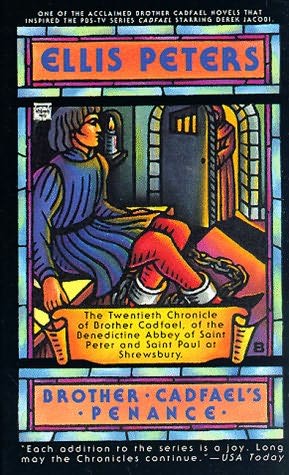
Brother Cadfael's Penance - Ellis Peters

brother cadfael's penance
ellis peters
c. 1994
292 pages
completed 5/23/2011

read for: historical fiction challenge

*may contain spoilers*

The Earl of Leicester's courier came riding over the bridge that spanned the Severn, and into the town of Shrewsbury, somewhat past noon on a day at the beginning of November, with three months' news in his saddle-roll.

The last adventure of the series sees Brother Cadfael embark on a personal mission. King Stephen and Empress Maud show no signs of ending their civil war and after the loss of a battle, many of the Empress' men are imprisoned in the castles of the King's men, most available for ransom, but some not. Cadfael discovers one of those men to be Olivier de Bretagne, the son he had only recently learned of. Cadfael travels with Hugh to a peace conference between the two factions in the hopes of discovering his son's whereabouts. While there, a murder takes place and an old friend of Cadfael's is accused, Yves Hugonin, now the brother-in-law of Olivier. Yves is taken prisoner by the same man whispered to be holding Olivier. Now Cadfael has two men to rescue, but his leave from his duties does not extend past the conference. Cadfael must choose between the home he loves and a son who has no knowledge of his father.

It's taken me a long time to get around to reviewing this. To be honest, I'm devastated that I read the last book. There's no more Cadfael. I've read all the books and seen all the Mystery! episodes (you should really rebroadcast those, Masterpiece Mystery). When I read the last page I seriously considered starting the first book over again. But no...I am finished. It's time to find a new mystery series (preferably one starring a Benedictine monk with his best friend the Sheriff of Shropshire).

This installment is a little odd in that the murder mystery plays a serious second banana to the story of Cadfael rescuing Olivier. This was somewhat similar to Summer of the Danes except in this case I was super enthralled with by Cadfael's rescue mission so I didn't really mind/notice the lack of mystery. 

The best part of the book, for me, was the odd friendship that developed between Cadfael and Phillip Fitz Robert, Olivier and Yves' captor. I think it's a testament to Peters' skill as an author that while Phillip could have easily been nothing but a monster, instead his relationships with Cadfael, Olivier, and even his father show him to be so much more. He turns out to be an extremely complicated and intelligent man, and one who was quite likable. Yes, his treatment of Olivier was unfair, but when it's understood it almost comes across as reasonable. His motives behind his more treasonous actions excellently add to his complexity. He is not a traitor for personal gain but for peace - anything to end the bloodshed. His grey thinking can't be understood by the black and white Olivier, making their relationship especially tense, but is understood by Cadfael. I was glad when he let Olivier go and then Olivier returned the favor by rescuing him from Empress Maud.

I was especially moved by one particular moment in the book. Empress Maud had attacked Fitz Robert's castle and when all was definitely lost and himself severely wounded, Fitz Robert allowed Cadfael to let Olivier out. The two then devised a plan to escape with Fitz Robert. It is during this meeting that Cadfael and Olivier come together both in full knowledge of their father/son relationship for the first time, and Olivier has to ask him for help into his armour and says "If I am going, as well go quickly. This once, my father, will you be my squire and help me to arm?" and I don't know. I was moved.

Lastly, I felt the ending was the perfect way to close out the series. To be honest, I wish there could have been one last scene between Cadfael and Hugh, but I don't think it could have been worked in. It would have been disrespectful and out of character to visit him before the Abbot, and it would have been anti-climactic after Abbot Radulfus' simple and beautiful "Get up now, and come with your brothers into the choir." So I'll take it as it is and just know in my heart that Cadfael and Hugh had many more adventures together.

If you haven't read these books, you need to immediately.

5/5

Tuesday, April 5, 2011

The Fourth Bear - Jasper Fforde

the fourth bear
jasper fforde
c. 2006
378 pages
completed 3/23/2011

read for: global challenge, tbr challenge

*may contain spoilers*


The little village of Obscurity is remarkable only for its unremarkableness.

Though they received recognition and praise for their work in the Humpty Dumpty murder, things are not going so well for Detective Inspector Jack Spratt, his partner Sergeant Mary Mary, and the rest of the gang at the Nursery Crimes Division. After some bad publicity for using children as live bait in an investigation, the NCD is overlooked when the Gingerbread Man, a psychopathic murderer, escapes from an institution for the criminally insane, and the case is handed over to another department, despite Jack being the arresting officer when the Gingerbread Man was first incarcerated. With no new cases thrown their way, the NCD begin investigating a missing persons case brought to them by an antagonistic reporter. His sister Goldilocks, an investigating journalist, has gone missing. Though at first they seem to be looking into some illegal porridge distribution, Jack can't seem to keep out of the Gingerbread Man's way and it's becoming more and more clear that the two cases have some kind of connection. If only Jack and Mary were allowed to investigate...

I've now read both books in the series and am eagerly awaiting the next one. I really enjoy all the random nursery rhyme and fairy tale characters (especially when they're just a name-drop that could really be easily missed such as the shout out to Bobby Shafto) and the world Jasper Fforde has created. It's not quite as awesome as Sondheim's Into the Woods, an incredible Broadway musical which explores what happens after "happily ever after," but it's close.

While reading, I did think at times there was a little too much going on without quite enough explanation. I remember thinking this during the first book too. I don't mean within the mystery, that I could follow pretty well, but just in the world itself. The politics regarding the social status of PDRs (Persons of Dubious Reality) and anthropomorphic bears could get a little confusing. Maybe some people would find the immense complexities Fforde is able to create an asset, but for me it detracted somewhat, however that could be just my own shortcoming.

Like the first of the series, I really enjoy the characters. Jack and Mary work so well together. And even the smaller characters are well fleshed out, especially those with folkloric backgrounds. It was exciting to see the way the famous foibles and characteristics manifested themselves, and to get explanations for plot holes in the original sources material (such as the disparate temperatures of the three bears' porridge). Though they initially really annoyed me, I ended up especially enjoying the inclusion if Punch and Judy. I really appreciate Fforde's inclusion of more obscure folklore references. I would have liked a little more time spent with Prometheus and Pandora, since there's obviously a history there. I'm interested to see where that will go. Maybe in the next one.

One last thing I just want to mention, and this is the only thing about the books that really annoys me. I don't like the little excerpts at the beginning of each chapter. They're like clippings from magazines and newspapers and history books (fictitious ones from the Nursery Crimes world) and for me, they add nothing. In fact, after the first few chapters, I just ignored them entirely.

4/5

Friday, February 18, 2011

Full Dark House - Christopher Fowler

full dark house
christopher fowler
c. 2003
349 pages
completed 1/26/2011

read for: historical fiction challenge, peculiar crimes unit mysteries

*may contain spoilers*

It really was a hell of a blast.

After the death of Arthur Bryant, his partner for over fifty years, John May, detective of London's Peculiar Crimes Unit, is determined to find his friend's murderer. His investigation keeps bringing up references to the very first case he and Arthur ever took on together. John has to dig into his memory to a time of blackouts and bombs to remember a grisly series of murders at the Palace Theater in order to avenge his friend.

I am almost finished reading the Brother Cadfael books and so I'm looking for a new series of mysteries to take their place. I was a little wary going into this one, since my sister the librarian said it was boring, but I should have just remembered she's also told me "The Woman in White" was boring which has turned out to be one of my favorite books. I think this will do nicely as a replacement series (though don't worry, Hugh Berringar, no one will ever replace you in my heart). It's not nearly as long as Brother Cadfael, but I believe the author isn't finished writing them. Anyway, onto actually talking about the book...

Since it was the first of the series, this is the book where not only do we, the readers, get to meet Arthur and John and their band of peculiars, but they get to meet each other for the first time. I really liked the way the meeting was done. Instead of starting at the beginning, we meet them on the day of Arthur's death and then travel back 65 years or so to the London Blitz and John and Arthur's first case together. Seeing the parallel between the first case and Arthur's murder kept the two stories well connected.

I loved Arthur and John. They were a great odd couple and that's what you want in a somewhat comical detective duo, like Shawn and Gus from Psych or Booth and Brennan from Bones (though maybe without the latter's romantic tension - of course this is only book one so who knows). John's a perfect newbie straight man to Arthur's tragically comic eccentric. I also liked how young they are. John's nineteen and Arthur's barely into his twenties, yet here they are, forced by the war to grow up pretty quick. But they've still got quite a bit of youthful exuberance and naivete. 

Lastly, I love when a book makes constant reference to another work (in this case: the operetta Orpheus in the Underworld by Jacques Offenbach). I love getting introduced to something else through the book I'm reading.

4/5

Friday, January 28, 2011

The Holy Thief - Ellis Peters

the holy thief
ellis peters
c. 1992
275 pages
completed 1/12/2011

read for: historical fiction challenge, page to screen challenge

*may contain spoilers*

In the height of a hot summer, in late August of 1144, Geoffrey de Mandeville, Earl of Essex, deferred to the heat of the sun, and made the final, fatal mistake of his long and opportunist career.

Ramsey Abbey had fallen prey to a band of soldiers of the Empress Maud's party who had left their cause for the more fortuitous pursuits of ransacking and pillaging northern England. The sudden death of Geoffrey de Mandeville left them without a leader and the monks were able to reclaim their abbey. Sub-Prior Herluin and his enigmatic companion Brother Tutillo travel to Shrewsbury in search of money, supplies, and labor to aid in Ramsey Abbey's rebuilding. They stay long enough to help the monks of Shrewsbury protect their treasures against a tremendous flood. When the flood is over and the monks of Ramsey leave, Shrewsbury discovers its most precious treasure, the bones of St. Winifred, is missing. It's quickly discovered to be making its way to Ramsey. Brother Cadfael aids Hugh Beringar to discover if the theft was the work of a man or if St. Winifred herself made her way into the cart. But before the matter can be settled, Cadfael and Hugh may find their holy thief to be a murderer as well.

As the penultimate book in the Brother Cadfael Chronicles, The Holy Thief doesn't disappoint. Brother Cadfael is right in the thick of things, befriending and aiding the accused, breaking some abbey rules in order to investigate, conferring and conspiring with Hugh and Abbot Radulfus. I was pretty disappointed with the last installment (see: Summer of the Danes), but this one was back on track.

Cadfael's relationship with St. Winifred has always been an element of these books that I've really enjoyed. Sometimes Cadfael can come across as slightly too practical for a monk so witnessing their communion is always nice, especially considering what's actually in St. Winifred's reliquary. I also really appreciated the balance between Cadfael's practical feelings on the trial by bible element of the theft (a scene I really enjoyed) as well as his experience of the miraculous as he interpreted the words. Though he knows those can easily be rigged and interpreted in many ways, the words spoke to him very specifically.

In every installment in the series there is always at least one set of lovers (one of which is usually the accused) that Cadfael helps to bring together. And USUALLY I always like them. There have been occasions where I wasn't wild about one or the other (again Summer of the Danes springs to mind). In this case, I liked both characters separately, but the two together left me cold. First off, they didn't interact a whole lot so I wasn't able to see and understand them falling in love. They seemed a little mismatched to me.

I always love when one of these books makes reference to characters and events from previous episodes. And this one had lots of shout outs: Brother Columbanus, Liliwin, and Soulien Blount, all from different books. Nice.

I only have one more to go. I'm going to be so sad to see the series end. :(

4/5

As I read this in part for the Page to Screen Challenge, check out my review of the 1998 TV-movie version here.

Monday, August 9, 2010

The Summer of the Danes - Ellis Peters

the summer of the danes
ellis peters
c. 1991
245 pages
completed 8/9/2010

read for: brother cadfael chronicles

*may contain spoilers*

The extraordinary events of that summer of 1144 may properly be said to have begun the previous year, in a tangle of threads both ecclesiastic and secular, a net in which any number of diverse people became enmeshed: clerics, from the archbishop down to Bishop Roger de Clinton's lowliest deacon, and the laity from the princes of North Wales down to the humblest cottager in the trefs of Arfon.

Brother Mark, who once was Brother's Cadfael assistant in the abbey's herb garden, has gone on to become a deacon to Bishop Roger de Clinton and has been sent as an envoy to the newly appointed Bishop Gilbert in the North of Wales. Needing an interpreter, his old mentor Cadfael is allowed to accompany him. But what should have been a quick and pleasant foray in Wales quickly turns more deadly Cadfael and Mark find themselves thrust into the middle of warring brother princes and foreign invaders.

I think this has to be my least favorite installment in the Brother Cadfael mysteries simply because there was no mystery. I mean, someone was murdered, but no one really cared too much because of the immediate threat of war. In the last chapter there is a deathbed confession by the murderer, but by that time you'd kind of forgotten who it was that had been murdered so you really didn't care. And Cadfael was really in no way involved. I think I've said it before, but I really like the formulaic nature of the earliest episodes and the ones that stray from that formula aren't nearly as good.

I also had a big problem with the lovers in this edition. In each mystery, there are always two people who are already in love or who fall in love that Cadfael kind of has to help out, and normally they're incredibly endearing and worthy of Cadfael's devotion. Occasionally there have been a few that have taken some time for me to warm up to, but eventually they always win me over. Not this time. Heledd was frosty and malicious towards her father (though I do agree she had some cause for this) and even kind of mean to Brother Mark in the beginning. And I love Brother Mark. There is no need to go out of your way to make him uncomfortable just because you think it's funny.

So to sum up there was no real mystery and an unsatisfactory love story. I did enjoy learning more about Prince Owain of Gwynedd and his family, but that's not enough. Sad.

3/5

Friday, June 25, 2010

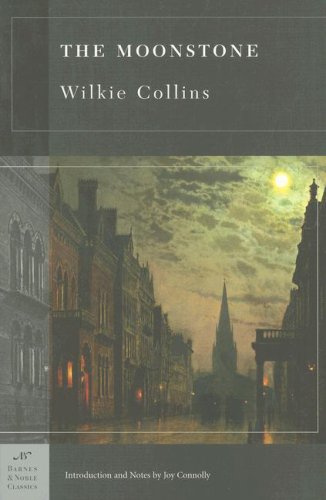
The Moonstone - Wilkie Collins

the moonstone
wilkie collins
c. 1868
494 pages
completed 6/24/2010

read for: wilkie collins mini challenge, penguin classics, 1001 books

*may contain spoilers*

I address these lines - written in India - to my relatives in England.

On her eighteenth birthday, Miss Rachel Verinder is surprised by a gift left to her by her late uncle Herncastle, a man mostly cut off from his relatives. The gift is an unusually large yellow diamond known as the Moonstone which she wears pinned to her dress throughout her birthday party. By the next morning, the Moonstone is gone. In a series of accounts written from different perspectives, those who were present on the night in question or those who had dealings with certain individuals of interest in the months after the theft, both the reader and all those involved are able to unravel the mystery.

I loved this book. LOVED IT! Set in Victorian England and hailed as the first English language detective novel, there is a lot of good stuff here: tension between the servants and those they serve, major red herrings in the mystery, the exotic excitement of Indian curses, sanctimonious religious zealots, and a lot of humor. I'm becoming a big fan of Wilkie Collins.

Because the novel is written in this specific epistolary style, each narrator has a very distinct voice and take on events and other characters. I found it really enjoyable to see how certain narrators portrayed themselves versus how other narrators saw them. For example, when Betteredge narrated he seemed so composed and respectable as the head steward of the Verinder servants, but when Mr. Blake or Mr. Jennings narrated, he was a little more quirky. The reader got to see Betteredge's feelings about the power of Robinson Crusoe, and then also see Mr. Blake and Mr. Jennings humoring this obsession. And by obsession, I mean he would read it the way some people read the bible. He would open it randomly and use the passage he first came to as advice or an omen. Another character who I found greatly changed between narrators was Mr. Bruff, the lawyer. Seen as so stuffy and judgmental as Miss Clack was writing her account, I was surprised to then find him so intelligent and thoughtful and kind throughout his narration and Mr. Blake's subsequent narration. Of course, by the end of her narration I was ready to take everything Miss Clack said with a grain of salt. She was just so ridiculously sanctimonious! I wanted to scream every time she tried to give someone else a religious tract (with titles such as Satan Under the Tea Table). I think she was the only character I couldn't wait to get rid of. Maybe Godfrey, too, but at least he was never a narrator.

I like a mystery where things get a bit convoluted before the big reveal. There's a big drug experiment close to the end of the novel where they tried to reenact the birthday party, and I kept having to refer to the first half of the novel to remember the little details that tuned out to be major clues. I like when every detail turns out to be important.

Unfortunately, there is one problem with this novel. Much like The Woman in White, another of Collins' most famous works, The Moonstone hasn't quite aged well. In the 142 years since its publication, we've come understand a little more about drugs and their effects. And while I have no personal knowledge of opium, having never chased the dragon myself, I'm pretty sure you can't manipulate circumstances into giving a person the exact same trip twice. So if you're not someone willing or able to suspend some disbelief, you might have a problem towards the end of the novel. It didn't bother me too much, but it could totally ruin the whole book for other readers.

Other than that one issue, I was enthralled the whole way through. It wasn't creepy or suspenseful the same way The Woman in White was, but it kept me thinking and guessing the whole way through.

5/5

Monday, April 26, 2010

The Potter's Field - Ellis Peters

the potter's field
ellis peters
c. 1989
230 pages
completed 4/20/2010

read for: brother cadfael chronicles

*may contain spoilers*

Saint Peter's Fair of that year, 1143, was one week past, and they were settling down again into the ordinary routine of a dry and favorable August, with the corn harvest already being carted into the barns, when Brother Matthew the cellarer first brought into chapter the matter of business he had been discussing for some days during the fair with the prior of the Augustine priory of Saint John the Evangelist, at Haughmond, about four miles to the northeast of Shrewsbury.

As a field newly attained by the Shrewsbury Abbey is plowed, the monks make a startling discovery. Buried at the very edge of the field, with hands neatly folded around a crude wooden cross, is the remains of a woman. With only a mane of black hair to identify her, Hugh Beringar is hard pressed to give the skeleton a name. Various tales of missing dark haired women begin surfacing, such as the companion of a peddler who dodges fee collectors at the Abbey's annual fair or the former wife of a newly tonsured brother of Shrewsbury. Brother Cadfael and Hugh Beringar must first identify their victim before they can even begin to discover her murderer.

I really don't want to keep reading the Cadfael books because I know that soon they're going to end. If I quit, I'll know there will always be more. I think I only have three more to go. I'll be so sad when they're all over. :(

Once again, I find it difficult to review a book where I have seen the movie so many times (I say movie, but I guess technically it was a television series). Also, seeing as this is the seventeenth Cadfael book I've read, I'm kind of running out of things to say. I always love the characters, Hugh especially. I love that there are always different reasons for the murder to take place. And this is no exception. In fact, I always felt that this particular mystery was quite surprising. What really happened is so hard for Cadfael and Hugh (and so the reader) to make out until all is revealed that even though I knew the movie really well, there were several times I honestly thought the outcome was going to be different in the book (ps, it wasn't). So I suppose that's quite good mystery writing.

I'm sorry this review is kind of boring...the book is not!

5/5

Saturday, January 9, 2010

The Heretic's Apprentice - Ellis Peters


the heretic's apprentice
ellis peters
c. 1990
250 pages
completed 1/9/2010

read for: brother cadfael chronicles

*may contain spoilers*

On the nineteenth day of June, when the eminent visitor arrived, Brother Cadfael was in the abbot's garden, trimming off dead roses.

So begins the sixteenth chronicle of Brother Cadfael. In this latest installment, Elave is newly returned from a pilgrimage with his master to the Holy Land. Upon his return, he is accused of heresy and called before Abbot Radolfus to answer the charges. After the hearing, Radolfus decides the case must be put before Bishop Roger de Clinton, however it will be several days before the Bishop is able to visit Shrewsbury. As they wait for his arrival, Elave's accuser turns up dead and naturally all fingers point to Elave. Who else had such a grudge against the man? Cadfael, who has taken a special liking to Elave, must team up with Sheriff Hugh Beringar to discover if Elave will be facing a murder trial as well as one for heresy.

It took me a little while to read this installment, but I think most of that is due to school starting up again this week so I've been a little busy. Had I not been busy, I probably would have zipped through it.

This was a great episode in the series. I like how even though there are always the same sort of stock figures in each book (most especially in the characters of the lovers), there are enough difference in characterization to not make the reader feel like you're reading the same story over and over. There are enough differences between Elave and say Torold Blund from One Corpse Too Many or Liliwin from The Sanctuary Sparrow to make the reader look at each character as an individual.

I especially enjoyed the theological discussion that made its way into this installment. While these books have Catholic monks at their center, there is often very little discussion of religion. It's very much just a background or setting, not a player in the story. Instead, this time we dove into the issue of heresy and what it meant to question the absolute truth of the Church during this time. There was some discussion of specific Catholic doctrines and specific Catholic writings and figures and I found myself extremely interested in that. It's funny that there is such mention of the writings of St. Augustine because I'm actually taking the History of Christianity as one of m classes this quarter and we're reading his Confessions.

If I haven't said it before, I think everyone should read this series and fall in love with Brother Cadfael. I like to think Cadfael and I could have been BFF.

5/5