Showing posts with label historical fiction challenge. Show all posts

Friday, August 19, 2011

I Will Repay - Baroness Emmuska Orczy

i will repay
baroness emmuska orczy
c. 1906
307 pages
completed 8/9/2011

read for: historical fiction challenge, TBR challenge, and scarlet pimpernel series

*may contain spoilers*

"Coward! Coward! Coward!"

In 1793, during the height of the French Revolution, Juliet Marney finds herself rescued from the Parisian sans-culottes by Paul Déroulède, a prominent figure in the National Convention. Déroulède is a passionate public speaker and is beloved by the people of Paris as a favorite of the recently martyred Marat and a staunch republican, someone who understands and speaks for the sans-culottes. Juliet and Déroulède continue to live together after her rescue, but soon realize that neither is exactly what they seem and could either be each other's salvation or damnation.

So, this is a Scarlet Pimpernel novel, but did you notice my complete lack of mention of the Pimpernel? Yeah, that was pointed. The Pimpernel is hardly in it at all. Yes, there is a daring rescue attempt by the end, and yes, you do eventually realize (or guess way in advance) that another minor though pivotal character from earlier in the novel was Sir Percy in disguise, but really this is not his story the way The Scarlet Pimpernel or Sir Percy Leads the Band are. This is very definitely the story of Juliet and Déroulède. I can see that some readers would be irritated by that, but I didn't mind it. I was definitively wrapped up in the story of Juliet and Déroulède, not to mention I just love reading about the French Revolution. But for others, the lack of Pimpernel could be a strong deterrent.

Orczy has an interesting voice as an author. I'm not sure how much of that comes from the time period she was writing in (1900s) or the subject matter, but she writes in an impassioned voice that's unusual in more modern works. It almost felt like she had written a speech (a really, really long speech) rather than a novel. In fact, I actually found that silently reading did a disservice to the prose and ended up reading most of it out loud. I realize that's super a little weird, and thankfully no one else was in the house, but it just seemed to sound better out loud. There are a lot of exclamation marks and bemoaning the fate of France at the hands of the sans-culottes.

I did have some issues with this particular edition (of course, I've since returned it to the library and so can't tell you which edition). There seemed to be quite a few typos. I mean, not on every page of anything, but enough so that I felt it to be distracting (especially while being a dork and reading out loud).

I just finished my very last college course (the final was literally this morning) which was on the French Revolution and it honestly made it so much more enjoyable to read this. It was like a supplement to the course, being able to read the story but pick out the events and figures that we'd been studying in class. I find it best to read historical fiction like this when I really feel like I know the basics of the period.

4/5

Thursday, August 11, 2011

The White Queen - Philippa Gregory

the white queen
philippa gregory
c. 2009
445 pages
completed 8/3/2011

read for: historical fiction challenge and read from my shelves challenge

*may contain spoilers*

In the darkness of the forest the young knight could hear the splashing of the fountain long before he could see the glimmer of moonlight reflected on the still surface.

When she walked with two sons to the crossroads to wait for the king, Elizabeth Woodville, a widow at age 27, only planned to ask for her dead husband's lands back. She didn't intend to fall in love and become Queen of England. Despite the rise in prominence and power her new position brings to her family, it also brings political struggles and death. Elizabeth makes instant enemies in those who don't like her influence over the king. Not to mention, the country is far from stable as cousins fight each other, each with a claim to the throne.

I've read all of Gregory's Tudor novels, but this is the first of her new series about the Cousin's War (more widely known as the War of the Roses). I think the third in the series comes out later this year and with (maybe?) a fourth one still to come. For anyone who keeps up with me and is familiar with this series, you can probably guess that it makes me crazy that the series' are not written in chronological order. So I try to look at them as stand-alone novels, and for the most part they can be. This book ends with a slight cliffhanger that hopefully gets picked up in a later novel, but otherwise they can be fairly solitary.

The last two Philippa Gregory books I read were split into three narratives, but this one reverts back to having only one. To be honest, I think this books could have benefited from having other narrators along with Elizabeth. Possibly someone like Elizabeth's brother Anthony or something like that (though I realize Anthony would prove to be a problem as a narrator 100 pages or so before the end of the novel)? My reason for this is that there's a lot of time when Elizabeth's not really doing anything, but there's so much going on politically and militarily. As a reader, I felt those episodes would have benefited from a more first hand account. There was just so much action that Elizabeth wasn't privy to that I felt her lone narration did a bit of disservice to the whole story. It could get a little boring with Elizabeth stuck in sanctuary just hearing about the battles. Not to mention, I honestly found the character of Elizabeth a little...I'm not sure, but I wasn't wild about her. She was a little too ambitious at the risk of her family, a little too calculating. Sadly much of her calculations didn't pan out the way she wanted.

One thing I was genuinely happy about was the relationship between Elizabeth and Edward. So often queens in these stories are so very unhappily married, and it's that unhappiness that adds weight and strength to part of their character. So many royal marriages are just horrible and so depressing to read about, which made the genuine love and devotion shown between Edward and Elizabeth incredibly refreshing. In fact, seeing as Elizabeth herself was not what was really drawing me into the story, upon the death of Edward and therefore their relationship I lost a lot of momentum in reading (the first 300 pages were read in three or four days and then the last 100 pages took me a few weeks). Their relationship was definitely uncommon. Politically, it made much more sense for Edward to marry a European princess, someone who could solidify his position as king. And with another royal family behind his children, I feel the little princes would have had a much stronger chance of surviving his death. Of course this is nothing but speculation...

Speaking of relationships, while I wasn't always wild about Elizabeth herself, I did greatly enjoy her family. Again, sometimes in historical fiction specifically about royalty, families don't act the way normal families do (being as they're not normal families). And that's definitely seen in the tenuous relationships between Edward and his brothers George and Richard. But Elizabeth and her family actually loved and supported each other. I loved her mother and I especially loved her brother Anthony. And I was glad we didn't spend too much time with her children other than her daughter (also named Elizabeth). I think it would have been too horrible to get attached to her sons.

I do have to point out that I could have done without the supernatural elements. I understand the reasons for adding them, that Elizabeth's mother was arrested (though acquitted) for witchcraft and that the women of the family claimed to be descendants of Melusina the water goddess, but I found they detracted from the book. I think I could have gotten behind Jaquetta and Elizabeth practicing witchcraft a little more if the results were more ambivalent, but I didn't like the blatant use of magic.

I think this was definitely a good start to a new series. Gregory does a good job of taking historical questions (such as the mystery of the princes in the tower) and creating very plausible answers for them. Of course we don't know what really happened, but the way the answers are presented make for a good argument or at least an interesting possibility. I'm looking forward to continuing the series with The Red Queen.

4/5

Monday, June 27, 2011

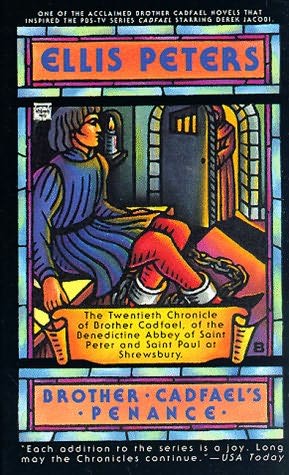
Brother Cadfael's Penance - Ellis Peters

brother cadfael's penance
ellis peters
c. 1994
292 pages
completed 5/23/2011

read for: historical fiction challenge

*may contain spoilers*

The Earl of Leicester's courier came riding over the bridge that spanned the Severn, and into the town of Shrewsbury, somewhat past noon on a day at the beginning of November, with three months' news in his saddle-roll.

The last adventure of the series sees Brother Cadfael embark on a personal mission. King Stephen and Empress Maud show no signs of ending their civil war and after the loss of a battle, many of the Empress' men are imprisoned in the castles of the King's men, most available for ransom, but some not. Cadfael discovers one of those men to be Olivier de Bretagne, the son he had only recently learned of. Cadfael travels with Hugh to a peace conference between the two factions in the hopes of discovering his son's whereabouts. While there, a murder takes place and an old friend of Cadfael's is accused, Yves Hugonin, now the brother-in-law of Olivier. Yves is taken prisoner by the same man whispered to be holding Olivier. Now Cadfael has two men to rescue, but his leave from his duties does not extend past the conference. Cadfael must choose between the home he loves and a son who has no knowledge of his father.

It's taken me a long time to get around to reviewing this. To be honest, I'm devastated that I read the last book. There's no more Cadfael. I've read all the books and seen all the Mystery! episodes (you should really rebroadcast those, Masterpiece Mystery). When I read the last page I seriously considered starting the first book over again. But no...I am finished. It's time to find a new mystery series (preferably one starring a Benedictine monk with his best friend the Sheriff of Shropshire).

This installment is a little odd in that the murder mystery plays a serious second banana to the story of Cadfael rescuing Olivier. This was somewhat similar to Summer of the Danes except in this case I was super enthralled with by Cadfael's rescue mission so I didn't really mind/notice the lack of mystery. 

The best part of the book, for me, was the odd friendship that developed between Cadfael and Phillip Fitz Robert, Olivier and Yves' captor. I think it's a testament to Peters' skill as an author that while Phillip could have easily been nothing but a monster, instead his relationships with Cadfael, Olivier, and even his father show him to be so much more. He turns out to be an extremely complicated and intelligent man, and one who was quite likable. Yes, his treatment of Olivier was unfair, but when it's understood it almost comes across as reasonable. His motives behind his more treasonous actions excellently add to his complexity. He is not a traitor for personal gain but for peace - anything to end the bloodshed. His grey thinking can't be understood by the black and white Olivier, making their relationship especially tense, but is understood by Cadfael. I was glad when he let Olivier go and then Olivier returned the favor by rescuing him from Empress Maud.

I was especially moved by one particular moment in the book. Empress Maud had attacked Fitz Robert's castle and when all was definitely lost and himself severely wounded, Fitz Robert allowed Cadfael to let Olivier out. The two then devised a plan to escape with Fitz Robert. It is during this meeting that Cadfael and Olivier come together both in full knowledge of their father/son relationship for the first time, and Olivier has to ask him for help into his armour and says "If I am going, as well go quickly. This once, my father, will you be my squire and help me to arm?" and I don't know. I was moved.

Lastly, I felt the ending was the perfect way to close out the series. To be honest, I wish there could have been one last scene between Cadfael and Hugh, but I don't think it could have been worked in. It would have been disrespectful and out of character to visit him before the Abbot, and it would have been anti-climactic after Abbot Radulfus' simple and beautiful "Get up now, and come with your brothers into the choir." So I'll take it as it is and just know in my heart that Cadfael and Hugh had many more adventures together.

If you haven't read these books, you need to immediately.

5/5

Thursday, March 10, 2011

An Artist of the Floating World - Kazuo Ishiguro

an artist of the floating world
kazuo ishguro
c. 1986
208 pages
completed 2/26/2011

read for: i want more challenge, global challenge, historical fiction challenge, tbr challenge, 100 greatest novels, 1001 books

*may contain spoilers*

If on a sunny day you climb the steep path leading up from the little wooden bridge still referred to around here as "the Bridge of Hesitation,"you will not have to walk far before the roof of my house becomes visible between the tops of two ginko trees.

Ono is a retired artist living in post war Japan. One daughter is married and the other is just beginning her marriage negotiations. Negotiations fell through for Noriko a year earlier leading Ono to look back on his involvement in World War II and attempt to understand how his actions have affected his life and the lives of those around him.

This was an interestingly structured book. I often don't like books that aren't linear and this has a lot of nonlinear elements. It jumps back in time from what's considered the present (1948-1950 Japan) to different memories before, during, and immediately after WWII. But it worked out for me since there was still one underlying linear story: Ono working towards his daughter's marriage negotiation. It was through this one linear story that Ono visits his memories. This is a story with an unreliable narrator. He remembers things differently in 1948 than he does in 1950. He goes through a period of remembering himself as someone who acted with honor during the war to someone who claims to be able to take responsibility for working in a way that now is not looked on well, creating propaganda for the country. However, he never quite comes around to understanding the real root of his dishonor and what he did to so horribly tear apart certain people's lives.

Ono is an extremely complex character and despite thinking that he's changing his perception of himself, he actually continues on in a state of denial. Ono's daughters and grandson are less complex, but instead stand to represent changing attitudes in Japan (and actually much of the rest of the world). The older daughter, subservient and always at the very least acting as if she's giving way to her father's wants, is representative of pre-war Japan. The younger daughter, who constantly butts heads with her father, and Ichiro, Ono's grandson who dreams of being an America cowboy, are indicative of the vast Americanization that occurred as a result of the end of World War II. While their characters might not be overly complex, what they represent helps to shape Ono's character.

4/5

Thursday, March 3, 2011

Of Love and Other Demons - Gabriel Garcia Marquez

of love and other demons
gabriel garcia marquez
c. 1994
147 pages
original language: spanish
completed 2/17/2011

read for: i want more challenge, what's in a name challenge, historical fiction challenge

*may contain spoilers*

An ash-gray dog with a white blaze on its forehead burst onto the rough terrain of the market on the first Sunday of December, knocked down tables of fried food, overturned Indians' stalls and lottery kiosks, and bit four people who happened t cross its path.

Don Ygnacio de Alfaro y Dueñas is a marquis in Spanish ruled South America (what is now Colombia), fading into obscurity with a wife who has been drugged into a state of near constant delirium. The daughter neither of them wanted has been pushed out of the house to be raised in the slave quarters, growing up speaking the Yoruban language of the slaves better than her own family's Spanish. It is only after she is bit by a rabid dog that Sierva Maria really comes to the attention of her father. Though she shows no signs of having contracted rabies herself, her bizarre behavior and mannerisms lead her father to conclude she is possessed by demons. Sierva Maria is sent to a convent to by exorcised. There, she develops a close relationship with Father Cayetano Delaura, the priest sent to oversee her ordeal, who may come to be possessed by an even more powerful demon: love.

Gariel Garcia Marquez is a beautiful writer. Beautiful. The emotional aspect of the detail is amazing. I always feel (I say always, yet this is only the second work of his I've read) that he is able to incorporate so much mundane life into his prose that in less capable hands would seem both irrelevant and kinda gross (in both this and Love in the Time of Cholera there is a passage or two that goes into some detail regarding specific characters' bodily functions). Instead, Marquez is able to make passages like those seem like such natural inclusions and ones that are vital to the integrity of the story. I don't often notice an author's prose style too much unless it bothers me, but Marquez stands out.

The novel (novella really) is very short, so there's not too much room for character development, but for those characters who needed it (Sierva Maria, Father Delaura, the Marquis) it was there in spades. Sierva Maria was quite the enigma. It's never really explained what her demon possession really is. For my part, I think her possession was nothing more than a cultural clash. She had been raised in the slave quarters, completely neglected by her family, so she was raised with different values, cultural norms, beliefs, and language. While differences like these would be expected from the African slaves, these perceived peculiarities were incomprehensible in their own daughter. Plus, she was basically tortured with "cures" for rabies, and that will really mess a person up.

I enjoy books that look into the historical practice of exorcism. It's often pretty terrifying and horrific, but fascinating at the same time. There were some extremely brutal processes to get rid of demons, and it's no wonder so many of them were fatal. My sister the literature scholar and I were discussing exorcist horror movies briefly last night, and I really think sometimes they should go the other way, with the horror part not being the person who's being possessed but the exorcism itself instead. Well, maybe they already do. I'm not so much into the horror movies...Scary stuff.

4/5

Friday, February 18, 2011

Full Dark House - Christopher Fowler

full dark house
christopher fowler
c. 2003
349 pages
completed 1/26/2011

read for: historical fiction challenge, peculiar crimes unit mysteries

*may contain spoilers*

It really was a hell of a blast.

After the death of Arthur Bryant, his partner for over fifty years, John May, detective of London's Peculiar Crimes Unit, is determined to find his friend's murderer. His investigation keeps bringing up references to the very first case he and Arthur ever took on together. John has to dig into his memory to a time of blackouts and bombs to remember a grisly series of murders at the Palace Theater in order to avenge his friend.

I am almost finished reading the Brother Cadfael books and so I'm looking for a new series of mysteries to take their place. I was a little wary going into this one, since my sister the librarian said it was boring, but I should have just remembered she's also told me "The Woman in White" was boring which has turned out to be one of my favorite books. I think this will do nicely as a replacement series (though don't worry, Hugh Berringar, no one will ever replace you in my heart). It's not nearly as long as Brother Cadfael, but I believe the author isn't finished writing them. Anyway, onto actually talking about the book...

Since it was the first of the series, this is the book where not only do we, the readers, get to meet Arthur and John and their band of peculiars, but they get to meet each other for the first time. I really liked the way the meeting was done. Instead of starting at the beginning, we meet them on the day of Arthur's death and then travel back 65 years or so to the London Blitz and John and Arthur's first case together. Seeing the parallel between the first case and Arthur's murder kept the two stories well connected.

I loved Arthur and John. They were a great odd couple and that's what you want in a somewhat comical detective duo, like Shawn and Gus from Psych or Booth and Brennan from Bones (though maybe without the latter's romantic tension - of course this is only book one so who knows). John's a perfect newbie straight man to Arthur's tragically comic eccentric. I also liked how young they are. John's nineteen and Arthur's barely into his twenties, yet here they are, forced by the war to grow up pretty quick. But they've still got quite a bit of youthful exuberance and naivete. 

Lastly, I love when a book makes constant reference to another work (in this case: the operetta Orpheus in the Underworld by Jacques Offenbach). I love getting introduced to something else through the book I'm reading.

4/5

Friday, January 28, 2011

The Holy Thief - Ellis Peters

the holy thief
ellis peters
c. 1992
275 pages
completed 1/12/2011

read for: historical fiction challenge, page to screen challenge

*may contain spoilers*

In the height of a hot summer, in late August of 1144, Geoffrey de Mandeville, Earl of Essex, deferred to the heat of the sun, and made the final, fatal mistake of his long and opportunist career.

Ramsey Abbey had fallen prey to a band of soldiers of the Empress Maud's party who had left their cause for the more fortuitous pursuits of ransacking and pillaging northern England. The sudden death of Geoffrey de Mandeville left them without a leader and the monks were able to reclaim their abbey. Sub-Prior Herluin and his enigmatic companion Brother Tutillo travel to Shrewsbury in search of money, supplies, and labor to aid in Ramsey Abbey's rebuilding. They stay long enough to help the monks of Shrewsbury protect their treasures against a tremendous flood. When the flood is over and the monks of Ramsey leave, Shrewsbury discovers its most precious treasure, the bones of St. Winifred, is missing. It's quickly discovered to be making its way to Ramsey. Brother Cadfael aids Hugh Beringar to discover if the theft was the work of a man or if St. Winifred herself made her way into the cart. But before the matter can be settled, Cadfael and Hugh may find their holy thief to be a murderer as well.

As the penultimate book in the Brother Cadfael Chronicles, The Holy Thief doesn't disappoint. Brother Cadfael is right in the thick of things, befriending and aiding the accused, breaking some abbey rules in order to investigate, conferring and conspiring with Hugh and Abbot Radulfus. I was pretty disappointed with the last installment (see: Summer of the Danes), but this one was back on track.

Cadfael's relationship with St. Winifred has always been an element of these books that I've really enjoyed. Sometimes Cadfael can come across as slightly too practical for a monk so witnessing their communion is always nice, especially considering what's actually in St. Winifred's reliquary. I also really appreciated the balance between Cadfael's practical feelings on the trial by bible element of the theft (a scene I really enjoyed) as well as his experience of the miraculous as he interpreted the words. Though he knows those can easily be rigged and interpreted in many ways, the words spoke to him very specifically.

In every installment in the series there is always at least one set of lovers (one of which is usually the accused) that Cadfael helps to bring together. And USUALLY I always like them. There have been occasions where I wasn't wild about one or the other (again Summer of the Danes springs to mind). In this case, I liked both characters separately, but the two together left me cold. First off, they didn't interact a whole lot so I wasn't able to see and understand them falling in love. They seemed a little mismatched to me.

I always love when one of these books makes reference to characters and events from previous episodes. And this one had lots of shout outs: Brother Columbanus, Liliwin, and Soulien Blount, all from different books. Nice.

I only have one more to go. I'm going to be so sad to see the series end. :(

4/5

As I read this in part for the Page to Screen Challenge, check out my review of the 1998 TV-movie version here.

Saturday, January 22, 2011

Scaramouche - Rafael Sabatini

scaramouche
rafael sabatini
c. 1921
406 pages
completed 1/8/2011

read for: historical fiction challenge, page to screen challenge

*may contain spoilers*

He was born with a gift of laughter and a sense that the world was mad.

Distraught after the murder of his childhood friend, Monsier Philippe Vilmorin, for his "dangerous gift of eloquence," Andre-Louis Moreau vows to see justice done. After being brushed off by the law due to the murderer being a Marquis, Andre-Louis takes to the streets of France to incite the Third Estate against the over privileged nobility, continuing the work Philippe died for, though he himself doesn't believe in his friend's idealism. His speeches, echos of Philippe's words, are considered treasonous, and Andre-Louis is forced to go into hiding. He takes up with a band of improvisational actors in the tradition of the Commedia dell'Arte, but he doesn't forget his vow to avenge Philippe or the politics that drove him into hiding. Andre-Louis's life becomes an adventure of secrecy and swashbuckling sword fights, set against the backdrop of the French Revolution, during which his original cynicism may yet become the idealism of his friend.

First off, I always love a strong and memorable opening line and this is definitely a great one. And it really sets the tone for the rest of the book. I don't often notice an author's particular writing style and sentence structure unless it annoys me, but this is one of the times when I noticed how much I felt it added to the story.

Plot-wise I found this book to be constantly engaging with elements of both drama and comedy. It had a good balance of both which I found refreshing. Sometimes adventure/swashbuckling stories like this can take themselves a little too seriously and be too straightforward. And at other times they can try to be a little too hyper-aware and fall over themselves trying to be in on the joke. I hope that made sense. There was a lot of humor, especially in Andre-Louis' scenes with the acting troupe, and some rather dark comedy when Andre-Louis would address the National Assembly after killing other Assemblymen in duels. Yet there was constant drama as well, both political (this is the French Revolution, after all) and much more personal.

I found certain aspects of the personal drama to be a little soapy (the identity of Andre-Louis' mother was obvious as soon as the woman was introduced, even though Andre-Louis had no idea), but for the most part it was deeply complex (I was SHOCKED by the identity of Andre-Louis' father). One aspect that really made the book enjoyable for me was the fact that the villain, the Marquis de la Tour d'Azyr, is introduced very much through the eyes of Andre-Louis and Philippe and so for the first half of the book he seems like nothing more than a monster. However, as the book goes on the reader is able to see him through his own eyes and really come to understand some of his motivations making him much more complex and more man than monster. At first these scenes seemed so incongruous with the way Andre-Louis viewed him, but eventually I was able to put all the pieces together to understand him more. By the end he's much more an antagonist than a straight up villain.

The last time I read a book that focused so much on the politics of the French Revolution, I really wasn't able to comment on the historical accuracy of that book (see: Mistress of the Revolution). This time, however, I was just coming off a history class on the French Revolution. I have to say, it's extremely enjoyable to read a historically set book and really feel like you have a solid grasp on the history of the time. I mean, let's be for real, one class hardly makes me an expert or anything, but having that knowledge really enhanced my enjoyment. I even have a historical quibble! In the book, Andre-Louis went from a member of the National Constituent Assembly to the Legislative Assembly newly created under the constitution of 1791. This would have been impossible, however, as Robespierre passed a "self-denying ordinance" barring any member of the National Assembly from sitting for the Legislative Assembly. This one quibble in no way detracted from my enjoyment of the book, though. In fact, it just made me feel smart. If there had been lots of mistakes, that would have been another story...

5/5

As I read this in part for the Page to Screen Challenge, check out my review of the 1952 film version.

Sunday, January 2, 2011

A few last minute additions...

Okay, it's official. I've gone insane and am signing up for two more challenges I'll never finish. To be fair, a lot of the books on these two lists are crossovers from other challenges (and one reread), but there are still a fair number of new ones, too. So here goes.

First, as a major lover of the movies, I'm joining the 2011 Page to Screen Challenge. I've decided to attempt the third level, so 15 books. 20 seemed like too many, but 10 was too few. Really, I want to do 12 to fit beautifully into the 12 months of the year, but 15 works, too. I'm also planning to participate by both reading and watching, so I'm going to watch all the movies too. My books will be...

1. Scaramouche - Rafael Sabatini
2. The Holy Thief - Ellis Peters
3. Lady Chatterley's Lover - DH Lawrence
4. Les Miserables - Victor Hugo
5. The Grapes of Wrath - John Steinbeck
6. La Mort d'Arthur - Thomas Malory
7. Catch-22 - Joseph Heller
8. The Great Gatsby - F Scott Fitzgerald
9. I Will Repay - Baroness Emmuska Orczy
10. Jane Eyre - Charlotte Bronte
11. Water for Elephants - Sara Gruen
12. The Name of the Rose - Umberto Eco
13. Mystic River - Dennis Lehane
14. Eduring Love - Ian McEwan
15. Harry Potter - JK Rowling

And the other is the Historical Fiction Challenge. What with my love of history and all, this one's kind of obvious for me. And in this instance I decided to just go crazy and choose the highest level "severe bookaholism," or 20 books. I know. Right after I posted above that 20 was too many. My books will be...

1. Scaramouche - Rafael Sabatini
2. The Holy Thief - Ellis Peters
3. Full Dark House - Christopher Fowler
4. Of Love and Other Demons - Gabriel Garcia Marquez
5. Brother Cadfael's Penance - Ellis Peters
6. The Glass of Time - Michael Cox
7. I Will Repay - Baroness Emmuska Orczy
8. The Diamond - Julie Baumgold
9. The Revolt of the Eaglets - Jean Plaidy
10. The Blue Star - Tony Early
11. The Heart of the Lion - Jean Plaidy
12. Water for Elephants - Sara Gruen
13. The Maiden with the White Hands - Rosalind Miles
14. Small Wars - Sadie Jones
15. When Christ and His Saints Slept - Sharon Kay Penman
16. The Name of the Rose - Umberto Eco
17. Dragonwyck - Anya Seton
18. The White Queen - Philippa Gregory
19. The Day the Falls Stood Still - Cathy Marie Buchanan
20. An Artist of the Floating World - Kazuo Ishiguro