Monday, August 1, 2011

By the end of August...

Okay, yes, as you may have noticed from the fact that I've not posted since July 3, July turned into the month where I didn't read a single book. I've got maybe 30 pages left of The White Queen which I've been reading since the last day of June, and I've started The Liar's Club, I Will Repay, and Bombay Time, but haven't really gotten more than about 25 pages into any of them. I actually don't like to read more than one book at a time (unless I've got school books or a REALLY big book that I can only read in small increments) which I think is why I haven't really gotten into those three. I'm dragging my feet horribly on The White Queen  and to be honest, I'm not entirely sure why. I read the first 300 pages in incredibly good time (for me) but then something happened and I can't really bring myself to read more than a few pages at a time. It's possible that my enjoyment changed after a certain character died (is it really a spoiler if it's history?), but I'm not sure. Anyway. Hopefully I can force myself to finish it tomorrow and move on.

To be Read by the End of August
The White Queen - Philippa Gregory
I Will Repay - Baroness Emmuska Orczy
Bombay Time - Thrity Umrigar
Dragonwyck - Anya Seton
Amsterdam - Ian McEwan

I was asked after I posted my last monthly goal if I ever finish these monthly lists, and the answer is almost always no. But I think that's okay. I may not always (or ever) complete things, but at least I have goals. :)

Sunday, July 3, 2011

Doctor Faustus - Christopher Marlowe

doctor faustus
christopher marlowe
premiered 1592
69 pages
completed 5/29/2011

read for: HSTEU305 (european witch trials)

*may contain spoilers*


Not marching now in fields of Trasimene / Where Mars did mate the Carthaginians, / Nor sporting in the dalliance of love / in courts of kings where state is overturned / Nor in the pomp of proud audacious deeds / Intends our muse to vaunt his heavenly verse.

A fifteenth century German, Georg Faustus, was a learned man with a reputation for magic. He studied at Heilderberg where he showed an interest in occult topics and was an example of the Renaissance magic tradition, a renewed interest in sorcery and other such learned magics. He was an actual figure around whom myths and legends have sense sprung up. Christopher Marlowe's Doctor Faustus is just one of many versions of this tale. In his play, Doctor Faustus is a learned man with an insatiable thirst for knowledge and power. He sees magic as the ultimate form of both and so makes a pact with the devil, his soul in exchange for twenty-four years of magical power. As the time for payment draws near, Faustus grows fearful and contemplates whether his damnation is inevitable or if its not too late to repent.

I read this for school, for my History of European Witch Trials class (which I kept accidentally referring to as simply my "witchcraft" class, as if I'd ditched the University of Washington for Hogwarts) and wrote a paper on it, so I was reading it for a very specific purpose. Rather than for enjoyment in the story, I was reading it as a text on Reformation belief in diabolism (demon worship) and the rejection of Catholic tradition. And in those instances, there is a wealth of information (enough to write an 8 page paper) from the deeper theological questions (if this is a Reformation text, is Faustus automatically damned for his diabolism or is there room for repentance?) to the more comically superficial (such as Faustus demanding Mephistophiles, his demon friend, appear to him as a Franciscan friar). Which is probably good, seeing as how otherwise, it's really kind of boring. Faustus is kind of a jackass. He didn't have enough depth to him to make me care why he chose to consort with devils. Not a whole lot happens, either. I wish when he got his powers he actually used them for something. Instead he did a few tricks and at one point traveled to Rome to screw with the Pope. But there was nowhere near twenty-four years worth of magical happenings. Not even twenty-four years of mischief.

I do think a good portion of my boredom comes from reading the text as opposed to seeing it performed. It's one thing to actually see devils carry him off to his fate at the end of the play, leaving the viewer without a concrete resolution (sometimes it just goes dark, sometimes screams are heard, and sometimes bloody limbs are thrown back on stage as if the demons tore his soul right out of his body), but reading nothing but sparse stage directions leaves a reader a little cold.

There's a faction of people who believe that Christopher Marlowe was the actual author of all Shakespeare's plays, and after reading this I have to believe those people are crazy (no offense if you're on of those crazies). There's a reason why Shakespeare is taught over and over, with whole classes devoted to nothing but his work, and why Christopher Marlowe is relegated to a week in my History of Witch Trials class.

3/5

Friday, July 1, 2011

Music Mix Friday...Florence + the Machine "Kiss with a Fist"

By the end of July...

Okay, so I only made it through one of the books from last month, but that's okay. It's only one extra for this month. We'll see what happens.

To be Read by the End of July
The White Queen - Philippa Gregory
The Liar's Club - Mary Karr
Bombay Time- Thrity Umrigar
The Name of the Rose - Umberto Eco
Small Wars - Sadie Jones
Amsterdam - Ian McEwan

To be read...

The Suspicions of Mr. Whicher - Kate Summerscale
The Pun Also Rises - John Pollock
Outlaw - Angus Donald
Miss Peregrine's Home for Peculiar Children - Rasom Riggs
The Lover's Dictionary - David Leviathan
Tigerlily's Orchids - Ruth Rendell
Alias Grace - Margaret Atwood
The Uncoupling - Meg Wolitzer
A Wild Surge of Guilty Passion - Ron Hansen
The Resevoir - John Milliken Thompson
Bossypants - Tina Fey
Game of Patience - Susanne Alleyn
Trespass - Rose Tremain
A Mountain of Crumbs - Elena Gorokhova
Herland - Charlotte Perkins Gilman
The Three Miss Kings - Ada Cambridge
The Invisible Bridge - Julie Orringer
The American Heiress - Daisy Goodwin
Finding Emilie - Laurel Corona
Vaclav and Lena - Haley Tanner
Please Look After Mom - Kyung-Sook Shin
Swamplandia - Karen Russell
Lady of the English - Elizabeth Chadwick
The Finkler Question - Howard Jacobson
Everything Beautiful Began After - Simon Von Booy
Sepulchre - Kate Mosse
The Night Circus - Erin Morgenstern
When God Was a Rabbit - Sarah Winman
The Match - Romesh Gunesekera
Butterfield 8 - John O'Hara
The Dark Mirror - Juliet Marillier
The Lake - Banana Yoshimoto
Flappers and Philosophers - F Scott Fitzgerald
Airmail - Naomi Bulger
Case Histories - Kate Atkinson
The Valley of Heaven and Hell - Susie Kelly
Ghost Light - Joseph O'Connor
Adverbs - Daniel Handler
Crome Yellow - Aldous Huxley
The Novel in the Viola - Natasha Solomons
Incognito - Gregory Murphey
Queen Pokou - Veronique Tadjo
In Lucia's Eyes - Arthur Japin
The Good Soldier - Ford Madox Ford
The Rest is Silence - Carla Gulfenbein
The Assault - Harry Mulisch
The Tea Lords - Hella S Haasse
The Slaves of Solitude - Patrick Hamilton
The Collaborator - Margaret Leroy
The Story of Beautiful Girl - Rachel Simon
Leonard's Swans - Karen Essex
Virgin Widow - Anne O'Brien
The Forest Lover - Susan Vreeland
The Goose Girl - Shannon Hale
Bloody Foreigners - Robert Windor
Miss Buncle Married - DE Stevenson (2nd in a series)
The Winter Queen - Boris Akunin (1st in a series)
The Manservant Mysteries - Lee Herman (series)
Children and Fire - Ursula Hegi (series)

55 new books and 4 new series. Every time this list grows longer, it's almost a little sad.

Monday, June 27, 2011

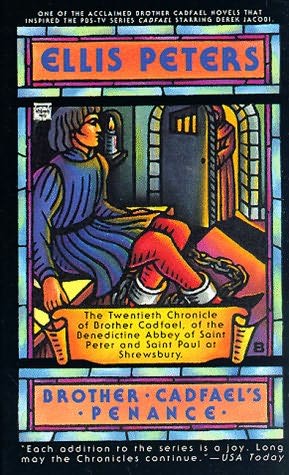
Brother Cadfael's Penance - Ellis Peters

brother cadfael's penance
ellis peters
c. 1994
292 pages
completed 5/23/2011

read for: historical fiction challenge

*may contain spoilers*

The Earl of Leicester's courier came riding over the bridge that spanned the Severn, and into the town of Shrewsbury, somewhat past noon on a day at the beginning of November, with three months' news in his saddle-roll.

The last adventure of the series sees Brother Cadfael embark on a personal mission. King Stephen and Empress Maud show no signs of ending their civil war and after the loss of a battle, many of the Empress' men are imprisoned in the castles of the King's men, most available for ransom, but some not. Cadfael discovers one of those men to be Olivier de Bretagne, the son he had only recently learned of. Cadfael travels with Hugh to a peace conference between the two factions in the hopes of discovering his son's whereabouts. While there, a murder takes place and an old friend of Cadfael's is accused, Yves Hugonin, now the brother-in-law of Olivier. Yves is taken prisoner by the same man whispered to be holding Olivier. Now Cadfael has two men to rescue, but his leave from his duties does not extend past the conference. Cadfael must choose between the home he loves and a son who has no knowledge of his father.

It's taken me a long time to get around to reviewing this. To be honest, I'm devastated that I read the last book. There's no more Cadfael. I've read all the books and seen all the Mystery! episodes (you should really rebroadcast those, Masterpiece Mystery). When I read the last page I seriously considered starting the first book over again. But no...I am finished. It's time to find a new mystery series (preferably one starring a Benedictine monk with his best friend the Sheriff of Shropshire).

This installment is a little odd in that the murder mystery plays a serious second banana to the story of Cadfael rescuing Olivier. This was somewhat similar to Summer of the Danes except in this case I was super enthralled with by Cadfael's rescue mission so I didn't really mind/notice the lack of mystery. 

The best part of the book, for me, was the odd friendship that developed between Cadfael and Phillip Fitz Robert, Olivier and Yves' captor. I think it's a testament to Peters' skill as an author that while Phillip could have easily been nothing but a monster, instead his relationships with Cadfael, Olivier, and even his father show him to be so much more. He turns out to be an extremely complicated and intelligent man, and one who was quite likable. Yes, his treatment of Olivier was unfair, but when it's understood it almost comes across as reasonable. His motives behind his more treasonous actions excellently add to his complexity. He is not a traitor for personal gain but for peace - anything to end the bloodshed. His grey thinking can't be understood by the black and white Olivier, making their relationship especially tense, but is understood by Cadfael. I was glad when he let Olivier go and then Olivier returned the favor by rescuing him from Empress Maud.

I was especially moved by one particular moment in the book. Empress Maud had attacked Fitz Robert's castle and when all was definitely lost and himself severely wounded, Fitz Robert allowed Cadfael to let Olivier out. The two then devised a plan to escape with Fitz Robert. It is during this meeting that Cadfael and Olivier come together both in full knowledge of their father/son relationship for the first time, and Olivier has to ask him for help into his armour and says "If I am going, as well go quickly. This once, my father, will you be my squire and help me to arm?" and I don't know. I was moved.

Lastly, I felt the ending was the perfect way to close out the series. To be honest, I wish there could have been one last scene between Cadfael and Hugh, but I don't think it could have been worked in. It would have been disrespectful and out of character to visit him before the Abbot, and it would have been anti-climactic after Abbot Radulfus' simple and beautiful "Get up now, and come with your brothers into the choir." So I'll take it as it is and just know in my heart that Cadfael and Hugh had many more adventures together.

If you haven't read these books, you need to immediately.

5/5

Wednesday, June 22, 2011

Maurice - EM Forster

maurice
em forster
c. 1913
246 pages
completed 6/20/2011


*may contain spoilers*

Once a term the whole school went for a walk - that is to say the three masters took part as well as all the boys.

Maurice tells the story of Maurice Hall, a middle class boy growing up in Edwardian England. At Cambridge he befriends Clive Durham, and as the two become intimate their friendship quickly blossoms into love. Though the two remain almost inseparable during the first few years after they leave university, a trip to Greece causes a change of heart in Clive. He comes home "fixed" and marries a woman names Anne, breaking Maurice's heart. Due to his devastation at losing Clive, Maurice too becomes determined to cure himself of the "disease" of homosexuality.

I think I kind of read this at a bit of the wrong time. I watched the movie due to a recent actor obsession (damn you BBC Sherlock and your silver fox Lestrade - who can be seen in the sidebar as my current tv boyfriend) and completely fell in love. I thought the movie was excellent and kept watching bits of it over and over on youtube (especially Maurice and Alec's last scene at the boathouse). Then I discovered my sister owned the book so I had to read it immediately, and so since I'm currently so enamored of the movie and Alec Scudder especially, I don't know how objective I can be about the book.

This book was written in 1913 but due to its subject matter (where the main character is not only a homosexual who is portrayed mostly positively, but one who *SPOILER* gets a happy ending with the man he loves) wasn't published until the 70s, after Forster's death. So it's less known than some of his other works. I found it interesting that though homosexuality is obviously the crux of the novel, it is the class distinction and tension between Maurice and Alec, something always featured so prominently in Forster's work (I say this like I've actually read anything else of his - well, I've seen the movies!), that is really the more pervading issue. Alec is only the under gamekeeper of Penge and Maurice is a guest there. As such, Alec isn't even noticed by Maurice (or even the reader really) for quite sometime. The use of a homosexual relationship, bringing two men of very different backgrounds together, is an interesting way to showcase the beginning disintegration of the European class system during this time. I love when books are obviously about one thing but are really, sneakily about something else, too.

It took longer for me to read this than I think I would have had I not seen the movie. It's Maurice and Alec who are the real love story (or to be fair to Clive's love for Maurice, they are the happy ending) and so I did feel like I had to slog through Clive a bit in order to get to Alec. Not that Clive is not a worthwhile or interesting character. His sudden abandonment of his homosexual leanings is a curious thing. It's a little ambiguous as to whether he really did grow out of it or if he still held those feelings but no longer allowed himself to act on them. The movie gives an actual answer to this question by adding a sad ending to the story of Clive and Maurice's university pal Risley that's not in the original story. While some purist may be super against this addition by the filmmakers, I actually thought it added a lot. It explained Clive's transformation and also made it clear to modern viewers just how dangerous it was for homosexuals at this time in England. Readers in 1913 (even though the book wasn't published then) would be aware of the dangers, whereas people today might not realize it was a jail-able offence (and had at one point in English history been an offence worthy of execution). Anyway, like I said, even though Clive is an intriguing character, I was impatient to get to Alec who is just so wonderful.

I just loved this story, book and movie alike, and I am pretty sure they'll be ones I revisit again and again.

5/5

Monday, June 20, 2011

By the end of June...

Like I said in my last post, the wheels have completely fallen off the wagon. I'm so behind in my plans for the year that I'd have to stop living and just read non stop in order to finish everything I planned. Seeing as I'm starting my last quarter of college, as much fun as it might be I don't see that happening. If anything, after adding a move to Santa Barbara upon graduation to this last quarter of school, I will have even less time devoted to reading (plus let's be for real, I have a sizable amount of tv to watch if I want to be caught up for the Emmys...and I do).

In light of these plans, I have decided to scale back on the amount of challenges I'm signed up for. Normally I would throw up my hands in despair and quit everything, but things have fallen apart so early this year that I think I have the opportunity to re-prioritize instead of just giving up. Because of how behind I am in them compared to some of the others, I've decided to pull out of the Back to the Classics, What's in a Name, Page to Screen, and Global Challenges. This still leaves me with the South Asian, I Want More, Historical Fiction, Reading From My Shelves, and TBR Challenges. So there's still a lot to be read and maybe more to be given up. We'll see how it goes.

As there's still ten days left in June, I still have time to get a little bit done this month. So here's an abbreviated goal.

To be Read by the End of June
The White Queen - Philippa Gregory
Theft: a Love Story - Peter Carey

Think I can finish two books in ten days? Don't be surprised if I fall way short of this teeny tiny goal. Ha. :)

Friday, June 17, 2011

Music Mix Friday...Eddie Murphy "Party All the Time"

So I haven't posted in a while, and even worse than that I kinda quit reading for a while. The usual excuses apply, I suppose. The quarter ended and I don't know what happened, but for the last three weeks I was basically a hermit all cooped up in my bedroom working on all my final papers, exams, and presentations. Thankfully it all paid off except for one class (postwar European history and I are currently taking a break and reevaluating our relationship), but it put a serious wrench in my book plans for the year. So much so that I didn't even bother to put up a list of June books since I know that list will only cause me to sink into a deep depression (or just laugh uncontrollably). Instead, I'm spending the next few days restructuring my reading plans for the second half of the year, taking into account my final quarter of school (graduating in August, whaaaaat?), my September move to sunny Santa Barbara, and my obsession with being caught up on all things television in time for the Emmys. And while doing this restructuring, I think I'll take a little time to get my Party on.