Monday, June 27, 2011

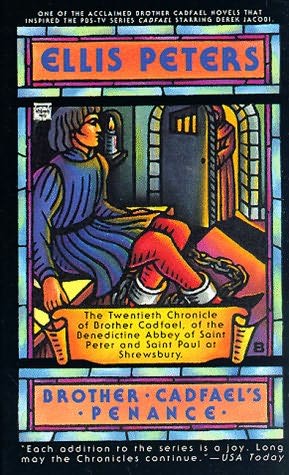
Brother Cadfael's Penance - Ellis Peters

brother cadfael's penance
ellis peters
c. 1994
292 pages
completed 5/23/2011

read for: historical fiction challenge

*may contain spoilers*

The Earl of Leicester's courier came riding over the bridge that spanned the Severn, and into the town of Shrewsbury, somewhat past noon on a day at the beginning of November, with three months' news in his saddle-roll.

The last adventure of the series sees Brother Cadfael embark on a personal mission. King Stephen and Empress Maud show no signs of ending their civil war and after the loss of a battle, many of the Empress' men are imprisoned in the castles of the King's men, most available for ransom, but some not. Cadfael discovers one of those men to be Olivier de Bretagne, the son he had only recently learned of. Cadfael travels with Hugh to a peace conference between the two factions in the hopes of discovering his son's whereabouts. While there, a murder takes place and an old friend of Cadfael's is accused, Yves Hugonin, now the brother-in-law of Olivier. Yves is taken prisoner by the same man whispered to be holding Olivier. Now Cadfael has two men to rescue, but his leave from his duties does not extend past the conference. Cadfael must choose between the home he loves and a son who has no knowledge of his father.

It's taken me a long time to get around to reviewing this. To be honest, I'm devastated that I read the last book. There's no more Cadfael. I've read all the books and seen all the Mystery! episodes (you should really rebroadcast those, Masterpiece Mystery). When I read the last page I seriously considered starting the first book over again. But no...I am finished. It's time to find a new mystery series (preferably one starring a Benedictine monk with his best friend the Sheriff of Shropshire).

This installment is a little odd in that the murder mystery plays a serious second banana to the story of Cadfael rescuing Olivier. This was somewhat similar to Summer of the Danes except in this case I was super enthralled with by Cadfael's rescue mission so I didn't really mind/notice the lack of mystery. 

The best part of the book, for me, was the odd friendship that developed between Cadfael and Phillip Fitz Robert, Olivier and Yves' captor. I think it's a testament to Peters' skill as an author that while Phillip could have easily been nothing but a monster, instead his relationships with Cadfael, Olivier, and even his father show him to be so much more. He turns out to be an extremely complicated and intelligent man, and one who was quite likable. Yes, his treatment of Olivier was unfair, but when it's understood it almost comes across as reasonable. His motives behind his more treasonous actions excellently add to his complexity. He is not a traitor for personal gain but for peace - anything to end the bloodshed. His grey thinking can't be understood by the black and white Olivier, making their relationship especially tense, but is understood by Cadfael. I was glad when he let Olivier go and then Olivier returned the favor by rescuing him from Empress Maud.

I was especially moved by one particular moment in the book. Empress Maud had attacked Fitz Robert's castle and when all was definitely lost and himself severely wounded, Fitz Robert allowed Cadfael to let Olivier out. The two then devised a plan to escape with Fitz Robert. It is during this meeting that Cadfael and Olivier come together both in full knowledge of their father/son relationship for the first time, and Olivier has to ask him for help into his armour and says "If I am going, as well go quickly. This once, my father, will you be my squire and help me to arm?" and I don't know. I was moved.

Lastly, I felt the ending was the perfect way to close out the series. To be honest, I wish there could have been one last scene between Cadfael and Hugh, but I don't think it could have been worked in. It would have been disrespectful and out of character to visit him before the Abbot, and it would have been anti-climactic after Abbot Radulfus' simple and beautiful "Get up now, and come with your brothers into the choir." So I'll take it as it is and just know in my heart that Cadfael and Hugh had many more adventures together.

If you haven't read these books, you need to immediately.

5/5

Wednesday, June 22, 2011

Maurice - EM Forster

maurice
em forster
c. 1913
246 pages
completed 6/20/2011


*may contain spoilers*

Once a term the whole school went for a walk - that is to say the three masters took part as well as all the boys.

Maurice tells the story of Maurice Hall, a middle class boy growing up in Edwardian England. At Cambridge he befriends Clive Durham, and as the two become intimate their friendship quickly blossoms into love. Though the two remain almost inseparable during the first few years after they leave university, a trip to Greece causes a change of heart in Clive. He comes home "fixed" and marries a woman names Anne, breaking Maurice's heart. Due to his devastation at losing Clive, Maurice too becomes determined to cure himself of the "disease" of homosexuality.

I think I kind of read this at a bit of the wrong time. I watched the movie due to a recent actor obsession (damn you BBC Sherlock and your silver fox Lestrade - who can be seen in the sidebar as my current tv boyfriend) and completely fell in love. I thought the movie was excellent and kept watching bits of it over and over on youtube (especially Maurice and Alec's last scene at the boathouse). Then I discovered my sister owned the book so I had to read it immediately, and so since I'm currently so enamored of the movie and Alec Scudder especially, I don't know how objective I can be about the book.

This book was written in 1913 but due to its subject matter (where the main character is not only a homosexual who is portrayed mostly positively, but one who *SPOILER* gets a happy ending with the man he loves) wasn't published until the 70s, after Forster's death. So it's less known than some of his other works. I found it interesting that though homosexuality is obviously the crux of the novel, it is the class distinction and tension between Maurice and Alec, something always featured so prominently in Forster's work (I say this like I've actually read anything else of his - well, I've seen the movies!), that is really the more pervading issue. Alec is only the under gamekeeper of Penge and Maurice is a guest there. As such, Alec isn't even noticed by Maurice (or even the reader really) for quite sometime. The use of a homosexual relationship, bringing two men of very different backgrounds together, is an interesting way to showcase the beginning disintegration of the European class system during this time. I love when books are obviously about one thing but are really, sneakily about something else, too.

It took longer for me to read this than I think I would have had I not seen the movie. It's Maurice and Alec who are the real love story (or to be fair to Clive's love for Maurice, they are the happy ending) and so I did feel like I had to slog through Clive a bit in order to get to Alec. Not that Clive is not a worthwhile or interesting character. His sudden abandonment of his homosexual leanings is a curious thing. It's a little ambiguous as to whether he really did grow out of it or if he still held those feelings but no longer allowed himself to act on them. The movie gives an actual answer to this question by adding a sad ending to the story of Clive and Maurice's university pal Risley that's not in the original story. While some purist may be super against this addition by the filmmakers, I actually thought it added a lot. It explained Clive's transformation and also made it clear to modern viewers just how dangerous it was for homosexuals at this time in England. Readers in 1913 (even though the book wasn't published then) would be aware of the dangers, whereas people today might not realize it was a jail-able offence (and had at one point in English history been an offence worthy of execution). Anyway, like I said, even though Clive is an intriguing character, I was impatient to get to Alec who is just so wonderful.

I just loved this story, book and movie alike, and I am pretty sure they'll be ones I revisit again and again.

5/5

Monday, June 20, 2011

By the end of June...

Like I said in my last post, the wheels have completely fallen off the wagon. I'm so behind in my plans for the year that I'd have to stop living and just read non stop in order to finish everything I planned. Seeing as I'm starting my last quarter of college, as much fun as it might be I don't see that happening. If anything, after adding a move to Santa Barbara upon graduation to this last quarter of school, I will have even less time devoted to reading (plus let's be for real, I have a sizable amount of tv to watch if I want to be caught up for the Emmys...and I do).

In light of these plans, I have decided to scale back on the amount of challenges I'm signed up for. Normally I would throw up my hands in despair and quit everything, but things have fallen apart so early this year that I think I have the opportunity to re-prioritize instead of just giving up. Because of how behind I am in them compared to some of the others, I've decided to pull out of the Back to the Classics, What's in a Name, Page to Screen, and Global Challenges. This still leaves me with the South Asian, I Want More, Historical Fiction, Reading From My Shelves, and TBR Challenges. So there's still a lot to be read and maybe more to be given up. We'll see how it goes.

As there's still ten days left in June, I still have time to get a little bit done this month. So here's an abbreviated goal.

To be Read by the End of June
The White Queen - Philippa Gregory
Theft: a Love Story - Peter Carey

Think I can finish two books in ten days? Don't be surprised if I fall way short of this teeny tiny goal. Ha. :)

Friday, June 17, 2011

Music Mix Friday...Eddie Murphy "Party All the Time"

So I haven't posted in a while, and even worse than that I kinda quit reading for a while. The usual excuses apply, I suppose. The quarter ended and I don't know what happened, but for the last three weeks I was basically a hermit all cooped up in my bedroom working on all my final papers, exams, and presentations. Thankfully it all paid off except for one class (postwar European history and I are currently taking a break and reevaluating our relationship), but it put a serious wrench in my book plans for the year. So much so that I didn't even bother to put up a list of June books since I know that list will only cause me to sink into a deep depression (or just laugh uncontrollably). Instead, I'm spending the next few days restructuring my reading plans for the second half of the year, taking into account my final quarter of school (graduating in August, whaaaaat?), my September move to sunny Santa Barbara, and my obsession with being caught up on all things television in time for the Emmys. And while doing this restructuring, I think I'll take a little time to get my Party on.

Tuesday, May 24, 2011

The Improper Life of Bezellia Grove - Susan Gregg Gilmore

the  improper life of bezellia grove
susan gregg gilmore
c. 2010
256 pages
completed 5/9/2011

read for: i want more challenge

*may contain spoilers*


Apparently among those who consider their social standing some measure of importance, I am to be admired for I am one of the view Nashvillians who can claim with infallible certainty that a blood relative had lived in this town since its inception.

Bezellia Grove is the last in a long line of first born daughters named for their pioneering ancestor who picked up her dead husband's musket in order to fight off the attacking Chickamauga tribe (though the accuracy of the story is debatable). Growing up in an affluent and wealthy family, Bezellia's life should be breezy and idyllic. But as her mother descends into alcoholism, her father becomes more and more distant, and her younger sister enters her teens still making mud pies and clinging to her doll Baby Stella, Bezellia's life is anything but. She finds herself drawn to the family she creates from the African American help, Maizelle the family cook and Nathaniel the driver. Her life takes a turn when she develops a friendship with Nathaniel's son Samuel and Bezellia is introduced to 60s Tennessee racism first hand.

While I have to admit I enjoyed Gilmore's first novel Looking for Salvation at the Dairy Queen better, I still really enjoyed Bezellia. Southern lit like this can sometimes be dismissed as merely fluff, but she tackles some heavy topics like alcoholism and racism and inter-racial relationships in a very realistic and non sugar coated or fantastical way. I found the inclusion on some not-so-nice remarks from Bezellia's cousin, who was all for Bezellia's crush on Samuel, to be more telling of the blatant racism than any of Mrs. Grove's hysteric outburst. Mrs. Grove is portrayed throughout much of the book as a somewhat larger than life villain (before we come to see her as more complex) so it's kind of accepted that of course someone like that would be racist. But Bezellia's cousin is supposed to be a good character, someone on Bezellia and Samuel's side. For her to make those comments shows how deeply rooted the racism was.

I did find some fault (maybe that's the wrong word??) in the characterization of Maizelle and Nathaniel. In my opinion, I viewed them as a little too...perfect? Against the villainy of Mrs. Grove they were almost angelic in their long suffering and unconditional love for Bezellia and her sister. I thought they were a little too influenced by Mamie or Uncle Tom stereotypes (Maizelle a little more than Nathaniel) in their devotion to Bezellia. It wasn't super blatant or anything, just something that I picked up on. Samuel, on the other hand, was an entirely different matter, a well rounded character and equal to Bezellia.

As for the ending, I was somewhat torn. The hopeless romantic in me wished Samuel and Bezellia could have taken on the world, but the historian in me was more satisfied that they didn't.

4/5

Tuesday, May 17, 2011

Slow Man - JM Coetzee

slow man
jm coetzee
c. 2005
263 pages (189 pages read)
stopped reading 4/30/2011

read for: tbr challenge

*may contain spoilers*

The blow catches him from the right, sharp and surprising and painful, like a bolt of electricity, lifting him up off the bicycle.

After being hit by a car while out riding a bicycle, Paul must relearn how to live and get around as an amputee, dependent on others. He refuses to entertain the idea of a prosthetic limb, opting instead to remain on crutches. Due to a lack of family, Paul is assigned a nurse to look him, Marijana, a Croation mother of three. Paul forms an attachment to Marijana and her children, but she is a married woman. Paul has to decide what, if anything, he wants to do. Helping him along is Elizabeth, an eccentric author who takes up residence in Paul's flat. Though Paul and Elizabeth have never met before this time, she seems to have more stake in Paul's action than would be expected.

Sadly, I didn't finish this book, so I don't know how Paul and Marijana's story ended. I have no idea if they got together (though I hope they didn't).

For the first third of the book, I was really enjoying it. It was a simple story, an older amputee falling in love with his younger and very married nurse. Their story was good. The developing relationship between Paul and Marijana's children was good. The confrontation between Paul and Marijana's husband was good. I was even amused by the fact that I had a hard time not pronouncing Marijana's name as marijuana. All good.

And then Elizabeth was introduced.

The introduction of Elizabeth completely changed the course of the book. Instead of a simple story of a man and his somewhat inappropriate love for his nurse, the book changed suddenly into a work of meta-fiction. Elizabeth was not only a character of the book, she was the author. She was pulling the strings, prodding Paul to act. Elizabeth interacts with Paul but he's not really a real person, he's one of her characters.

It's entirely possible I could have gotten behind this had the book held this meta theme from the beginning. But once I've gone through 100 pages invested in the relationship between patient and nurse, it's hard to shift focus to such a radically different relationship between author and character. I don't like when there is such a drastic shift in theme and focus.

I very much enjoyed the voice of the author which is why it took me so long to make the decision to abandon the book. I feel I should continue looking into JM Coetzee, but this book just turned out not to be for me.

1/5

Sunday, May 15, 2011

One Amazing Thing - Chitra Banerjee Divakaruni

one amazing thing
chitra banerjee divakaruni
c. 2009
220 pages
completed 4/13/2011

read for: south asian challenge

*may contain spoilers*

When the first rumble came, no one in the visa office, down in the  basement of the Indian consulate, thought anything of it.

Expecting an ordinary day with nothing more than a few inconveniences, several people have gathered at an Indian consulate in American. Each are preoccupied with their own lives and give little notice to each other as they wait to finish getting visas. Their lives quickly come together, however, when they are hit by an earthquake and become trapped in the basement of the consulate. As their situation becomes more and more dire, the companions, with little else to pass the time, tell each other their stories.

It hadn't happened in a while, but I read this book in only two days. Maybe not such a feat for others (as the book is only 220 pages) but I tend to read annoyingly slow. But I found this extremely hard to put down. I've been pretty unmotivated lately, either to read much or blog or even read other people's blogs, but I'm trying to get all three back on track.

I read this about a month ago, so the review may be a little lacking or disjointed, so I'm sorry.

I always find it especially enjoyable when I feel a personal connection to what I'm reading, especially if that personal connection is something somewhat arbitrary. Like when I'm reading a historical fiction novel and they happen to be discussing an aspect of history that I just learned about in one of my classes or something like that. In this book, I noticed pretty early on in their time together, that the group stuck in the consulate were going through the five stages of team building. When I served in AmeriCorps, we ended up having to talk about team building all the time, and we'd do all those ridiculous games and exercises to make sure we had smooth running teams. It's one of those things that is important to do, but everyone kind of hates doing it so you have to kind of make fun of it. I spent two years in AmeriCorps and we talked about team building (or I guess were lectured about team building) all the time. So it was kind of funny for me to read this and make note of when they transitioned into the next stage. For anyone interested the five stages are forming (when you first meet), storming (when everyone is fighting), norming (when the team starts to understand how everyone else works), performing (when you're able to work at the team's utmost potential), and celebrating (when the job's all done). I wish they could have come up with a rhyming word for the fifth stage.

I found myself enthralled with the stories told by the group of trapped people. Just as I like certain members of the group more than others (I'm looking at you, Mr. Pritchett. You were super annoying), I liked certain stories more than  others. I particularly enjoyed the stories set in India. I had no idea there was such a history of Chinese emigration to India and subsequent racism against them. I really enjoyed Mangalam and Malathi's stories of being almost forced to come to America. The Pritchett's stories both left me a little cold, however.

The only major issue I had with the book was the end, and part of that is just my own personal preference. I don't enjoy ambiguous resolutions, and we're left not knowing if the group is rescued and survives (for my part, I'm apparently a Debbie Downer because I don't think they did). And also, I don't think I totally got the ending of Uma's story, the deal with whether or not the aurora was real. I didn't realize that was questionable until she said she lied to Jeri. Maybe I should re-read the last chapter and see if I have any divine revelations.

4/5

Sunday, May 1, 2011

By the end of May...

And now we've gotten to the point when writing up what needs to be read each month to keep on track is just laughable. Sad that I only made it four months before my challenges spiraled out of control.

To be Read by the End of May
Catch-22 - Joseph Heller
Against Nature - Jori-Karl Huysmans
Mirror Mirror - Gregory Maguire
La Mort d'Arthur - Thomas Mallory
The In-Between Life of Vikram Lall - MG Vassanji
The Improper Life of Bezellia Grove - Susan Gregg Gilmore
The Liar's Club - Mary Karr
Amsterdam - Ian McEwan
Brother Cadfael's Penance - Ellis Peters
I Will Repay - Baroness Emmuska Orczy

I often find it difficult to read FIVE books in a month. I really think I'm going to get anywhere with TEN???? Ha!

To be read...

Other People We Married - Emma Straub
The Girl Who Would Speak for the Dead - Paul Elwork
The Uncoupling - Meg Wolitzer
The Midnight Palace - Carlos Ruiz Zafon
Exponential Apocalypse - Eirik Gumeny
The Last Brother - Nathacha Appanah
Mermaid - Carolyn Turgeon
The Beauty of Humanity Movement - Camilla Gibb
The Lover's Dictionary - David Levithan
The Beloved Dead - Tony Hays (3rd in a series)

9 new books and 1 new series. Not too much this month around...