Sunday, August 8, 2010

Jim the Boy - Tony Early

jim the boy
tony early
c. 2000
256 pages
completed 7/22/2010

read for: tbr challenge

*may contain spoilers*

During the night something like a miracle happened: Jim's age grew an extra digit.

Jim is a boy living in a small town in North Carolina during the Great Depression. During the year he turns ten his life teaches him lessons on friendship, family, and what it means to be a man.

It's been a little while since I finished this book. My head has been in another space the past week since I just moved to a new apartment in Seattle with my sister the literature scholar. So this review is probably going to be a little short. I should have written it closer to when I had finished it.

This was a very quiet little book. Much of it was very sweet and somewhat idyllic: a small boy living with a mother and uncles who love him whose biggest problem seemed to be a competition with another boy from school to see who was better at everything. Things took a bit of a turn at the end and Jim came in contact with some much bigger issues (poverty and polio among other things). For the most part, though, I was reminded of books like Little Women and Little House on the Prairie with simple episodic life lessons.

4/5

Monday, August 2, 2010

By the end of August...

I don't really know how but July kind of got away from me. I got through basically nothing. I say this month will be different, but let's be for real. It won't be...

To Be Read by the End of August
Oscar and Lucinda - Peter Carey
Possession - AS Byatt
The Known World - Edward P Jones
On Beauty - Zadie Smith
Cleopatra's Daughter - Michelle Moran

To be read...

The King's General - Daphne du Maurier
The Scarlet Contessa - Jeanne Kalogidis
Purge - Sofi Oksaner
The Secret Confession of Anne Shakespeare - Arliss Ryan
Whiter Than Snow - Sandra Dallas
Mrs. Tim of the Regiment - DE Stevenson
The Mystic Art of Erasing All Signs of Death - Charlie Huston
Finny - Justin Kramon
Nightingale Wood - Stella Gibson
Where's My Wand? - Eric Poole
Empress Orchid - Anchee Min
Talking to Girls About Duran Duran - Rob Sheffield
My Name is Mary Sutter - Robin Oliveira
The Devil Amongst the Lawyers - Sharyn McCrumb
The Amelia Peabody Mysteries - Elizabeth Peters (series)

14 new books and 1 new series. Wow. Not too many added this month...

Friday, July 23, 2010

Music Mix Friday...The Beatles "Yellow Submarine"

What British invasion would be complete without the Beatles? My sister the literature scholar comes home on Sunday. What better way to celebrate her return from England than with our own Beatlemania in the form of the Beatles song she hates the most? You would not believe how many people have made cartoon videos of this song. It's out of control.

Thursday, July 22, 2010

The Queen's Lady - Barbara Kyle

the queen's lady
barbara kyle
c. 1994 (as a dangerous temptation)
525 pages
completed 7/16/2010

read for: year of the historical challenge

*may contain spoilers*

She would remember this forever after as the night she watched two men die, one at peace and one in terror.

After the death and simultaneous excommunication of her father, Honor Larke is taken under the guardianship of a greedy and devious noble and an equally evil priest. Several years later she is rescued by Sir Thomas Moore and brought up as his ward during which time she is noticed by the Queen of England, Catherine of Aragon. Honor begins serving as one of her ladies-in-waiting and soon becomes a trusted confidante and letter carrier. However, after witnessing the burning of two heretics, one of whom was a childhood friend, Honor begins to question the religion she was brought up in and which is so enmeshed in the lives of her two benefactors (the Queen and Sir Thomas). Honor's questioning soon boils over into action as she teams up with two very different men, one rash and reckless and one cool and collected, in order to rid England of intolerance.

The synopsis on the back of this book gave me a very different idea of what this book was going to be. In no way did it mention religion and the tension between Protestants and Catholics and Honor becoming this Scarlet Pimpernel for Protestants character. I went into this expecting a very certain kind of historical fiction, something a little more serious, but what I got instead was a lot more melodramatic and outrageous. Maybe if I'd gone into this expecting it to be more crazy adventure I could have gotten behind it more. As it was, I found a lot of Honor's schemes unbelievable. Not just unbelievable, but unbelievably reckless and stupid. And kind of far-fetched, especially the time she was stuck in the hold of the ship for three days with no food or water and in order to save her, her partner set the boat on fire. It was just too over the top for me.

I also didn't find Honor's religious transformation all that believable. I understand that she was heartbroken by the death of Ralph. Believe me, I was too. If you are a servant boy in your late teens or early twenties and you have an absolute unwavering devotion to your mistress, especially one who is either a child or well into middle/old age, it's pretty much a given that I will fall for you. So yes, Honor's whole world was rocked when Ralph was burned as a heretic. But once she began to argue with Sir Thomas about the justification of his execution she lost me. She began the discussion assuming there had been a mistake and Ralph was innocent of heresy, but as soon as it had been proven to her that there was no mistake, that Ralph was indeed a Protestant, just like that (imagine fingers snapping) she changed her tune to argue that these heretical beliefs were okay to have. And that I couldn't buy. Honor had been described as a learned theologian. Sir Thomas had made sure to have Honor well educated, she corresponded with leading theologians of the time, so Protestant ideas could not have been new to her. To change her beliefs on the merits of Protestantism so suddenly made no sense to me.

As her new ideas on Protestantism made no sense to me, neither did most of the rest of her actions throughout the rest of the book as they all stemmed from this incident. Becoming the savior of the Protestants, Honor who before now was known as the Queen's last, most loyal lady-in-waiting, secretly teams up with Thomas Cromwell to get Anne on the throne, thinking she would lead the country to tolerance. Before, she had almost an infatuation with her guardian Sir Thomas, and now she does everything in her power to destroy him. The book even used Honor to give Cromwell the idea to make everyone swear an oath of succession, the oath that brought Sir Thomas to his death. She just so easily betrayed these people who loved her and gave her everything. I found it amusing that her name was Honor considering she really had none. It was so hard to get behind anything she did. Also amusing that though she seemed to be fighting so hard for tolerance of Protestantism, she seemed to have no tolerance of other people's religious beliefs. This book made sure to show the worst sides of religion, the greed and violence, (Catholic, Lutheran, and Anabaptist mostly) and not much of the good, turning Honor further and further into atheism. Which would have been fine had she not been so sanctimonious about how she had found the answers and that all religion was crap and those who couldn't see that were blind and stupid. I know there are two more books in this series but I don't think I will be reading them.

3/5

Monday, July 19, 2010

Movie Mondays

Still going with the 2010 Oscar nominees. Tonight we watched District 9. Well...okay, we watched about 20-25 minutes of it. I was surprised I even made it that far. I really don't do aliens. My mother didn't even make it all 25 minutes, opting instead to "rest her eyes" (read: sleep). Dad probably could have kept going, but he's leaving for Japan tomorrow and they'll probably offer it on the plane and he can watch it there without my probably uninvited commentary.

Keeping with the Oscar theme, I have a lifetime goal of watching all the films that have ever been nominated for one of the BIG SIX awards (best picture, lead and supporting actor,/actress and director), preferably in chronological order from the beginning of the Oscars to the present. Well, I say all but I left out the first two years or so since I have a hard time making it through a silent movie. And there are a lot from the early 30s that are hard to find and I'm not going to go out of my way to look for them (which is probably good...when I talk to my Dad about this project he tells me I need a hobby). I kind of started this project a few years ago and so far I watched 6 (you're super impressed, right?). And by I've watched 6, I mean a STARTED watching six. I've only finished watching 3. Today's movie Arrowsmith, based on the novel by Sinclair Lewis, was one of the ones I finished. And I have to say I liked it. Arrowsmith is a man with potential to become a great medical researcher, but puts his dream on hold when he falls in love and decides to get married. After several years as a country physician, he is given another chance to follow his dream as a medical researcher. After creating a serum that could possibly destroy any bacteria, he is sent to the West Indies to combat a breakout of bubonic plague, but while there he is met with ethical dilemmas. Should he treat his patients and conduct his experiments in the name of science or humanity? I think the novel it's based on takes a much more critical look at the medical profession of the time, looking for quick results and breakthroughs and publicity, but the movie only touches on that a little. There's also a lot more to Arrowsmith's character I believe. But still, I found the movie to be enjoyable. And it's significant in that it's the first American movie to feature a black character with a college degree and who wasn't characterized as a 1930s stereotypical African American (no tap dancing, poor speaking skills, etc).

Earlier in the week, continuing with the sports movie theme of last weeks A League of Their Own, Dad and I watched Pride of the Yankees. I have a hard time thinking of this movie without thinking of that Friends episode where Phoebe is watching movies she never realized were sad. "Pride of the Yankees? I thought yea, Yankee pride and then BAM! Lou Gehrig's disease." And then Richard's response, "They guy was Lou Gehrig. Didn't you kind of see that coming?" Classic. Anyway...I know this is supposed to be a classic tearjerker sports movie, but to be totally honest, it never really felt all that moving. Lou Gehrig kind of came off as a goober, even though he made a great good-bye speech. Too often conversation in movies from this time period comes across as a little unnatural, so it's hard to really get an emotional connection with anyone. I did really like Papa Gehrig. My biggest reaction to the movie was thinking the bracelet he gave his wife for their fourth anniversary, made up of medals he'd won throughout the years was kind of heinous. And then I felt bad when I realized the bracelet they used in the movie was the actual one he gave his wife and is now in the baseball hall of fame.

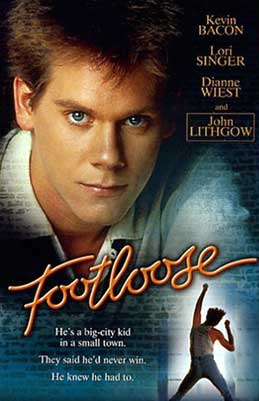
Knowing me to be a secret lover of all things 80s (I am an 80s baby after all), my sister the librarian brought Footloose home from the library the other day. Somehow this was a movie I had yet to see. I know, all of you are thinking JUMP BACK. But it's true. Somehow Footloose had evaded me. The situation now rectified, I'm pretty sure it's my new favorite movie. Sure it's a little far fetched and a little dated and a little campy, but sometime that is what makes a really excellent movie. And did you know it almost starred Rob Lowe instead of Kevin Bacon? Yeah, had that actually happened I'm pretty sure I would have seen this movie long ago.

And the last movie from the past week, The Greatest. It was a little independent movie from last year about an 18 year old girl who shows up at the home of two grieving parents 3 months pregnant from the one
night she spent with their son. The night he died. It's funny...had I read this synopsis for a book as opposed to a movie there's absolutely no way I would have read it. I don't do grief books. Too often I find them melodramatic and saccharine and a bit cliche. Not to say that all books dealing with grief should be characterized that way, but for me they don't connect and so I tend to stay away from them. That being said, movies that deal with grief I can often get behind. I don't know what it is about the different mediums. Maybe the fact that I can see their pain and despair in the tiny movements of their faces and in their unsaid words instead of the sometimes overwrought descriptions of those emotions. I really liked this movie. Though dealing with a very sad topic, there was also a lot of humor. I don't like movies to be too depressing. There needs to be a bit of a bright spot, and Rose, the pregnant girl was just that. I'm beginning to think I'd watch just about anything Carey Mulligan was in. The stoner little brother was fun, too. I always like the stoner kids in movies, I don't know why (though if I think about it, perhaps the stoner high school boyfriend has something to do with that...). Anyway, good movie. Sad, but hopeful. Maybe my dad's right. Maybe I do need a hobby...

What movies have you been watching this week?

Sunday, July 18, 2010

A Prayer for the City - Buzz Bissinger

a prayer for the city
buzz bissinger
c. 1998
379 pages
completed 7/16/2010

read for: hstaa303 (modern american civilization)

*may contain spoilers*

Success followed success and as he persuaded more and more people with the spontaneous symphony of his hands and the infectious rhythm of his voice to see a place he saw, it became easier to believe that there was something wondrous about him, regardless of the patches of hair sprouting from his head like a failed English garden, not to mention the balled-up blue suits that looked as if they had been burrowed away in gym bags.

During the early '90s, Buzz Bissinger enjoyed almost unfettered access to the Ed Rendell, mayor of Philadelphia. The information he gathered was used to novelize the first five years of Rendell's term in office attempting to rebuild a city that was falling apart. A Prayer for the City tells a story of race relations, unemployment, murder, but also one of hope and hard work. Littered with characters who worked within Rendell's administration such as his chief of staff David Cohen, as well as people just trying to survive in the city, such as Linda Morris, Fifi Mazzccua, Mike McGovern, and Jim Mangan, we are offered insight into the unimaginable struggles to keep America's cities afloat.

I was supposed to read this for my America History class this past quarter. And I did. Or at least I read about half of it by the time the final came around. But that was fine. I had read enough to participate in the discussions and write about it on final if I had to. Most books like this assigned for a particular class I would have abandoned as soon as I turned in that bluebook, but there was something that kept pulling me back to pick it up and read a little bit more. The people discussed were compelling and the draw of the city itself and wanting to see it get better forced me to continue. So here I am, a month after the quarter ended, finally finished with the book.

A Prayer for the City is non fiction but it's written almost as a novel. There's conversation and character development and a somewhat moving plot. We not only see the struggles of the city from the government's point of view, but also just from the people. We watch Mike McGovern make the decision to give up his life as a Philadelphia district attorney and take his family to the outskirts of the city and take up criminal defense. We see Jim Mangan soldier on during cut backs at the ship yard until the yard is closed entirely. And we see Fifi Mazzccua raise her children and grandchildren in a poor area of the city, some of whom fall into violence and jail time, but some who don't. It was easy to feel a connection the these people and a hope for them to succeed. Ed Rendell became mayor to one of the most struggling cities in America, but despite a lot of set backs and failures, there was progress.

4/5

Tuesday, July 13, 2010

Broken Paradise - Cecilia Samartin

broken paradise
cecilia samartin
c. 2007
340 pages
completed 7/11/2010

read for: tbr challenge

*may contain spoilers*

Dear Alicia, I'm told this letter may not get to you as the communists will cut it to shreds, but when I saw the picture of us together at Varadero beach I knew I had to write it anyway.

Alicia and Nora are more than cousins, they are best friends. Together, they spend an idyllic childhood in Paradise on the beaches of Cuba, with little more than laughter, love, and family around them. As children they don't always understand the politics their parents are discussing, wanting Cuba to rid itself of its President Batista and hold free elections. Alicia father Carlos is especially vocal in his opposition to President Batista and is instrumental in his eventual downfall. But Batista's downfall does not bring about the changes the people of Cuba were hoping for. Instead, with the rise of Fidel Castro and the Communist Party, the country begins to fall into poverty and Nora and Alicia's lives are changed forever. Nora's family emigrates to the United States to escape Cuba's ruin, but Alicia's family stays behind determined to stay true to Cuba. Though they stay connected by exchanging letters, both Nora and Alicia have a very different path to travel.

I think there might have been something a little off in the time line of this novel. Or if not that there was some simplification in the politics and the succession of Cuban presidents. With almost no knowledge of Cuban politics, from reading this book I took from it that immediately after President Batista's downfall Castro became President. But from the little bit of research I've been doing it seems that was not the case and that, while Castro was a leader among the rebellion that took down Batista, he didn't become President of Cuba until seventeen years later. So the time line of things seems to somewhat simplified or condensed.

Alicia and Nora's stories took completely different turns, but I felt that both were compelling. I did have a little trouble relating to Nora once she and her family escaped to California. I've never lived anywhere other than the US. I have lived in really different regions of the US, but my sister has always said I'm like a sponge and I'll almost immediately pick up the accent and regional dialects without even realizing it. I know you can't really compare moving to a new state to moving to a whole new country, but I don't think I would have held onto Cuba in quite the same way Nora did. It was so easy for Marta to embrace her new country, but it took Nora a long time. I think maybe it wasn't Cuba itself that Nora was clinging to, but Alicia. Because she couldn't let Alicia go, she couldn't let Cuba go. 

The culture clash between Nora and Jeremy I thought was very well done. Most of the time it was very subtle. As Nora learned English and tried to enmesh herself within American society, Jeremy was trying to learn Spanish and about Latino culture before being deployed with the Peace Corps. I think I got a little annoyed with him once he and Nora were reunited and began rekindling their relationship. He seemed to think that since he'd been to Peru with the Peace Corps he now understood what made Nora who she was. I felt he kind of steam rolled her a little when he pushed her to ignore the feelings of her parents and return to Cuba to visit Alicia. I agree that it was good she went back to Alicia, but I thought Jeremy's pushing was unfeeling of Nora's relationship with her parents and even her relationship with Cuba itself. I was not Jeremy's biggest fan.

While I was interested to see the different lives Alicia and Nora would live after each being forced down opposite forks in the road, I think I enjoyed the first third of the novel the best, and not just because that was the time when everything was happy. The descriptions of life in Cuba did seem like paradise, the beautiful beaches, the food, the family. This section was beautifully written and really transported the reader right to Cuba. It was interesting to me how life in Cuba before the revolution seemed so idyllic, yet there were still big social issues that were demonstrated in the beginning of the novel, specifically racism. While Beba and Lola were treated well and love by Nora's family, by being black women they were still of a different social status. Not everything in life before the revolution was perfect.

4/5

It's Tuesday, where are you?


The Queen's Lady
London, England 1527